It's that time of year for ice on and in the aircraft. Last year, we in HEMS crashed a machine due to liquid water (rain) getting into the skyward facing engine air inlet - which was covered by a particulate (dirt) barrier.
As temps dropped throughout the night, the liquid turned to ice. The crew launched on a flight, and the ice underneath the filter broke loose and got sucked into the turbine a short time after takeoff. The ice destroyed the engine and the aircraft did not autorotate successfully.
A warm hangar would have helped...
A special notice about this is here...
While installing inlet covers is a pain, if a hangar is not available, and it is going to rain on your aircraft as the temperatures drop, it may be something to consider. We at this base are going to have to go out and run the aircraft each cold morning to defrost the blades, or suffer a delay upon activation for a ground run and visual check of the rotor blades. If there is frost on the cars in the parking lot, there is frost on the blades...
safe flights...
News, safety related information, and personal experiences concerning taking care by air. All rights reserved.
pic
Saturday, November 9, 2013
Friday, November 1, 2013
Fuelish Mistakes...
Complacency and Fuel Don't Mix...
Jet Fuel.
We use it everyday we work, take it largely for granted, and seldom consider how much trouble it has and will continue to cause. Every step of fuel's existence; production, distribution, dispensation, and consumption creates the chance for human factors or human failings to wreak havoc. Mayhem is waiting in the wings. Just when we think we have everything figured out, someone invents a new way to put bad fuel into a good aircraft, or put good fuel where it doesn't belong. At best a flight is delayed or cancelled, at worst someone gets hurt or an aircraft gets destroyed.
I was doing some research a few years back, and stumbled across an account of a major fuel spill and accompanying lawsuit at a hospital - involving an aviation-services vendor, and the base mechanic. The fuel system at that location had an underground tank. The pump was situated so that people standing outside, especially with a running aircraft nearby, could not hear it. The mechanic fueled the aircraft and forgot to turn the pump off, so the hose remained pressurized, with only the valve in the nozzle to prevent fuel from flowing. Time passed, and the nozzle valve failed, and the pump did it's job and pumped about a thousand gallons of jet fuel all over the ground. The EPA fined the hospital hundreds of thousands of dollars, and the hospital... well, you can figure it out.
You can read about this event here...
Humans.
A couple of weeks ago, I was fueling an aircraft in South Carolina. The base there has a small "portable" fuel tank sitting near their T-hangar at the nearby airport. This system has a smaller-than-normal nozzle, without the rubber-cap that is commonly used to prevent foreign objects from getting inside. As it was the first time using the system that day, I was required by company policy to both sump the tank - draining a small amount of fuel from the bottom of the tank into a bucket - and also to sample the flow from the nozzle. With my medic and nurse watching (we were talking about something important like women, or beer, or fishing) I dutifully pointed the little nozzle into the bucket and squeezed the handle.
Something "foreign" spat out along with the flow of fuel, and each of us blurted, "what's THAT?" I let the foam clear and watched a tree-frog climb disgustedly from the fuel bucket and hop off to the showers, or where ever tree frogs go after swimming in jet fuel. If it hadn't been the first fueling of the day, and I hadn't checked the fuel into the bucket, that frog would have gone into our fuel tank...
Another incident similar to this happened to a friend of mine. They were flying from Columbia to Charleston South Carolina in a twin-engine BK-117, with two supply tanks being fed by transfer pumps in main tanks. As they rode along, the pilot noticed that the level in one of the supply tanks was dropping. What-the-hell?
There happened to be nurse sitting up front for this flight, instead of a medic, as it was an empty leg home and the nurses seldom had the chance. She watched with growing dismay as the emergency-procedure checklist was consulted, circuit-breakers were checked, and the main tank level was verified. The pump was "working," but the level in the tank was going down, and at empty an engine was going to quit. They were over a big swamp, and headed to the closest airport with a runway for a single-engine run-on landing. Most twins won't hover on one motor...
Inexplicably, just as they neared the Orangeburg airport, the level began to rise, and soon indicated topped-off. "Let's go home," they said and flew on to their base. It wasn't until later that the zip-lock bag that someone had dropped into the fuel-tank and missed during final inspections was discovered floating around inside the main tank. When it sloshed up against the inlet hole for the pump, fuel stopped moving. This happened twice to this particular base which is why they knew what to look for.
Negative habit transfer: Many aircraft have airframe mounted (in addition to the filter built into the engine) fuel filters, and on some aircraft these filters are designed to be drained or purged each day, to allow water out. But not all filters are so designed. In one recent case, a pilot who had transitioned from a Bell 206 and was used to draining his filter elected to drain the filter on his "new" aircraft. This allowed air to get into a space it shouldn't have, and resulted in an engine flame-out at a high-hover, and significant damage.
Speaking of the Bell 206 and it's filter, there is a sequence of steps used for this purging. I knew a pilot once who decided that the way the steps were written was dumb, because he routinely got fuel all over himself from the pressurized spray hitting the engine compartment deck and splashing up. He decided to change things up, and open the drain valve and then turn on the pump and let it flow. Only he got distracted one day and forgot to close the drain after turning off the pump. On his next flight, he flew from one platform in the Gulf of Mexico to another - thankfully very close - platform, at which an oilfield worker who was waiting for a ride commented on the steady stream of fuel draining from the aircraft as it came in to land...
Dumb. Dumb. Dumb. If the fuel boost-pumps mounted down in the fuel tank hadn't been putting more fuel into the filter housing than the engine was taking out, the engine would have sucked air and quit. Never deviate from an established procedure.
I did some work at a hospital in the mid-west once. I asked the guys there about sumping and sampling the fuel from the hospital's tanks, which were located well away from the dispensation point. "The mechanic takes care of that." I wonder how many times a pilot has taken it for granted that someone else is making sure the fuel going into the aircraft that he or she will soon climb into is actually clean and safe for use.
Day after day, when we take a sample and it comes out clean and bright, we are gradually reassured that our fuel procedures are okay, and if we miss a sample now and then, it won't matter. This is complacency trying to kill you. Perhaps the best scenario is when the base mechanic drives a diesel powered car or truck. Then we know darn well that fuel is regularly being sumped and sampled...
Sumping the aircraft tanks is a pain in the back and knees. Maybe the aircraft didn't fly since yesterday, when you took a sample. All you have to do is rub the mark off the sample jar and change the date... But wait, are you absolutely sure no one tampered with the aircraft? Are you positive no suspended water (in the fuel) has settled to the bottom of the tank? Want to be your life on it?
My current employer requires a letter from anyone we buy fuel from verifying that they comply with established fuel handling procedures. Unfortunately, letter-not-withstanding we don't really know if they have checked the fuel in the truck or tank we are getting fuel from unless we watch them do it, which isn't practical. If they don't have a letter on file, we are required to perform a quality-check on the spot before allowing the fuel into our aircraft. I wonder if anyone has actually done this at an airport - asked for a white bucket and sumped the airport's truck and sampled the hose? Again, it's not really practical in the middle of a patient transport with the crew waiting at the hospital. One thing I always do, letter on file or not, is look the guy in the eye and ask him if HE checked the fuel that day. I want to hear it from his mouth. Draining some fuel from the aircraft after fueling is complete is another option for checking the quality. I have cut a plastic water-bottle in half, wiped it out, and checked the fuel after buying it from a place I deemed sketchy.
We use fuel every day we work, and it's always ok - but there was that time in Savannah when I pumped a mayo jar full of water and mud from the base's filter-vessel. Now that got my attention. I picked up the radio and called us out-of-service. Then I went underneath the BK with another jar.
Once, while flying in Pennsylvania, I slid underneath a backup BK that Keystone (the old Keystone - gone now) had issued us. I went to push up on the little belly-drain plunger. It resisted, because the aircraft had recently been painted, and over-spray got on the plunger. I pushed harder and up the plunger went, and fuel flowed into my coke bottle. Then I relaxed upward pressure on the plunger, and it stayed "in". And fuel continued to flow. There I was laying underneath a helicopter with my finger on the hole in the drain hollering for one of my crew members. The mechanic had to come in and drain the tank and rebuild the drain. It turned out that not one person had sumped the belly of that aircraft since it left the paint shop - and that had been a while.
Complacency and fuel don't mix.
safe flights
Sunday, October 27, 2013
Flashback Friday:Being in the Right Place, At the Right Time, With the Right People...
edited 2/13/15
I was laying in bed the other morning, thinking about speaking to an international audience who were going to be listening to me not because they had to but because they chose to; a first-time event. I teach subject matter that is required by CAMTS, and the Code of Federal Regulations: the body that certifies air medical transport companies and the FAA. Thus far the folks in my classes have been there because the boss said so. I was trying to sort out how to approach the problem of being meaningful, and how to relate to the audience. Sitting in front of me would be all sorts of people filling all sorts of roles in health-care, from senior leaders to the newest entry-level healthcare provider, from pilots to paramedics to professional safety managers.
Finally I decided to just talk to the people who work where the metal meets the mud; the flight crews. When I lecture - I am talking to them, because I want them to stay alive. Tragically, as I was thinking these thoughts three persons were losing their lives in a helicopter.
In our industry, safety folks are all about implementing "safety-management-systems." One organization after another touts the fact that they have "exited level one, or two, or three" and so on, and to be sure I hope that eventually these things will help prevent accidents. But what about not dying right now? I attended a class in which a very smart, educated, and thoughtful pilot and safety executive put up slide after slide explaining that there really are lots of players in our game, and any one of multiple contributing factors can be why we crash aircraft and kill people. Good Stuff. How do I stay alive.
What about you, dear pilot, or nurse, or medic, or RT? What will you do to stay alive throughout your flying career? Do you have any personal strategies, or tricks, or philosophies on how to not get dead? If not, perhaps your should give this some thought. Because what we do is dangerous.
According to the American Journal of Clinical Medicine (Winter 2009 issue) after assessing past statistics then projecting them forward, they predicted that if you fly in a HEMS helicopter and do that job for twenty years, you face a 40 percent chance of losing your life.
Before I started writing this, sitting in my sun-room on a Sunday morning, I was reading the weekend-edition of the Wall Street Journal. This is a great paper, with tons of information that is way over my head, and - my favorite part - book reviews and excerpts. One article covers Dr. Thomas Lee, a professor of medicine at Harvard, and his new book "Eugene Braunwald and the Rise of Modern Medicine." In this article there is a line about Dr. Braunwald; "over six decades, he (Braunwald) was repeatedly in the right place, at the right time, with the right people."
BAM. Put the paper down and go get the computer. Start writing. (If you are not yet a blogger, this is how it goes. You are doing something and all the sudden...)
This is my advice to you, dear HEMS person who climbs into an aircraft and takes to the sky. Seek always to put yourself in the right place at the right time with the right people. It's as simple as that. If you are not sure where the right place is, educate yourself. Your heart and your head will tell you about the people. The time is now.
In the right place... I now fly a single engine aircraft. I have dedicated myself over the last year to continuously evaluate if I am in a position to survive the loss of that one engine. When I take off, I fly as close as possible to the way the operators manual says I should, at max-continuous power, at best-climb speed, to an altitude allowing a safe landing should my engine fail. I deliberately fly as if the motor is going to quit, even though the odds are that my engine won't. If I am not in the right place, I try and get there as quickly as possible. My new flying style elicits comments from the back like, "wow, I never saw this view from such a high altitude," and "gee, things sure look different from way up here." This at two thousand feet above the ground! Why do we persist in flying so low?
(added 2/13/15: There is an increased industry/FAA interest in over water flight. If you fly a single engine helicopter over water without floats and vests, I recommend you fly at an altitude or on a path such that no person could ever misunderstand or question your ability to reach the nearest shore. Such a misunderstanding got an excellent pilot - who formerly flew the president of the United States - fired.)
By way of explanation...The odds of a sprag-clutch failing to engage on engine-start are probably a billion to one. That happened to me in a BK, and resulted in around a million dollars worth of damage to the aircraft I was in command of. I am not immune to bad fortune. If an engine is going to quit, I take it for granted that it's going to quit on me. I don't want to be in the wrong place when it happens.
With the right people... I heard a story not long ago about a crew heading out to do a PR flight. There was a seasoned pilot at the controls, and a seasoned crew in back. Sometime in flight, or perhaps after landing and on shutdown, the paramedic smelled fuel. He keyed up the mic and announced "I smell fuel." The pilot acknowledged the message and continued on with what he was doing. They shut down and got out, and the pilot wasn't taking any actions related to the fuel smell. The medic began to look into all the openings in the side cowls and observed fuel dripping from a filter assembly. He said, "hey, we have a fuel leak!" The pilot looked and said, "don't worry about it, it's just a drip, these things do that," and walked off to check out the PR.
Time passed and they prepared to leave. The medic asked the pilot again about the fuel leak, the pilot became irritated and told him to get in.
The medic sat still for the engine start and run-up, then announced, "Hey I forgot something, I have to get out for a second." The pilot went back to idle and the medic climbed back out and with his flashlight peered through the opening in the cowl. Jet fuel was spraying in a gusher from the filter assembly...
The flight team in question subsequently decided that this pilot wasn't "the right people," and they cut him loose. Pilots reading this are perhaps excoriating me right now, and to be sure any of the people involved with our work can have the "wrong stuff." Whatever - your job is to actively monitor who YOU are flying with and make sure they are right for you, and for your safety. And you friend have to be the right person too.
At the right time... Our business is one of extreme consequence. A failure or mistake by a surgeon might lead to the death of a patient. A failure by any of us might lead to the death of all of us. So there is no "right time" to do things right. We have to do the right thing every time. All the time. We might let things slip or cut a corner, and get away with it. That will lead us to slip more and more often and eventually we will get caught. Conversely we might let things slip once - and that will be the day... We just don't know - so our job has to be done deliberately, and thoughtfully, and cooperatively - right now
If you are going to fly for two decades, and you don't want to be one of the forty-percent, make sure you keep yourself in the right place, at the right time, with the right people.
safe flights
I was laying in bed the other morning, thinking about speaking to an international audience who were going to be listening to me not because they had to but because they chose to; a first-time event. I teach subject matter that is required by CAMTS, and the Code of Federal Regulations: the body that certifies air medical transport companies and the FAA. Thus far the folks in my classes have been there because the boss said so. I was trying to sort out how to approach the problem of being meaningful, and how to relate to the audience. Sitting in front of me would be all sorts of people filling all sorts of roles in health-care, from senior leaders to the newest entry-level healthcare provider, from pilots to paramedics to professional safety managers.
Finally I decided to just talk to the people who work where the metal meets the mud; the flight crews. When I lecture - I am talking to them, because I want them to stay alive. Tragically, as I was thinking these thoughts three persons were losing their lives in a helicopter.
In our industry, safety folks are all about implementing "safety-management-systems." One organization after another touts the fact that they have "exited level one, or two, or three" and so on, and to be sure I hope that eventually these things will help prevent accidents. But what about not dying right now? I attended a class in which a very smart, educated, and thoughtful pilot and safety executive put up slide after slide explaining that there really are lots of players in our game, and any one of multiple contributing factors can be why we crash aircraft and kill people. Good Stuff. How do I stay alive.
What about you, dear pilot, or nurse, or medic, or RT? What will you do to stay alive throughout your flying career? Do you have any personal strategies, or tricks, or philosophies on how to not get dead? If not, perhaps your should give this some thought. Because what we do is dangerous.
According to the American Journal of Clinical Medicine (Winter 2009 issue) after assessing past statistics then projecting them forward, they predicted that if you fly in a HEMS helicopter and do that job for twenty years, you face a 40 percent chance of losing your life.
Before I started writing this, sitting in my sun-room on a Sunday morning, I was reading the weekend-edition of the Wall Street Journal. This is a great paper, with tons of information that is way over my head, and - my favorite part - book reviews and excerpts. One article covers Dr. Thomas Lee, a professor of medicine at Harvard, and his new book "Eugene Braunwald and the Rise of Modern Medicine." In this article there is a line about Dr. Braunwald; "over six decades, he (Braunwald) was repeatedly in the right place, at the right time, with the right people."
BAM. Put the paper down and go get the computer. Start writing. (If you are not yet a blogger, this is how it goes. You are doing something and all the sudden...)
This is my advice to you, dear HEMS person who climbs into an aircraft and takes to the sky. Seek always to put yourself in the right place at the right time with the right people. It's as simple as that. If you are not sure where the right place is, educate yourself. Your heart and your head will tell you about the people. The time is now.
In the right place... I now fly a single engine aircraft. I have dedicated myself over the last year to continuously evaluate if I am in a position to survive the loss of that one engine. When I take off, I fly as close as possible to the way the operators manual says I should, at max-continuous power, at best-climb speed, to an altitude allowing a safe landing should my engine fail. I deliberately fly as if the motor is going to quit, even though the odds are that my engine won't. If I am not in the right place, I try and get there as quickly as possible. My new flying style elicits comments from the back like, "wow, I never saw this view from such a high altitude," and "gee, things sure look different from way up here." This at two thousand feet above the ground! Why do we persist in flying so low?
(added 2/13/15: There is an increased industry/FAA interest in over water flight. If you fly a single engine helicopter over water without floats and vests, I recommend you fly at an altitude or on a path such that no person could ever misunderstand or question your ability to reach the nearest shore. Such a misunderstanding got an excellent pilot - who formerly flew the president of the United States - fired.)
By way of explanation...The odds of a sprag-clutch failing to engage on engine-start are probably a billion to one. That happened to me in a BK, and resulted in around a million dollars worth of damage to the aircraft I was in command of. I am not immune to bad fortune. If an engine is going to quit, I take it for granted that it's going to quit on me. I don't want to be in the wrong place when it happens.
With the right people... I heard a story not long ago about a crew heading out to do a PR flight. There was a seasoned pilot at the controls, and a seasoned crew in back. Sometime in flight, or perhaps after landing and on shutdown, the paramedic smelled fuel. He keyed up the mic and announced "I smell fuel." The pilot acknowledged the message and continued on with what he was doing. They shut down and got out, and the pilot wasn't taking any actions related to the fuel smell. The medic began to look into all the openings in the side cowls and observed fuel dripping from a filter assembly. He said, "hey, we have a fuel leak!" The pilot looked and said, "don't worry about it, it's just a drip, these things do that," and walked off to check out the PR.
Time passed and they prepared to leave. The medic asked the pilot again about the fuel leak, the pilot became irritated and told him to get in.
The medic sat still for the engine start and run-up, then announced, "Hey I forgot something, I have to get out for a second." The pilot went back to idle and the medic climbed back out and with his flashlight peered through the opening in the cowl. Jet fuel was spraying in a gusher from the filter assembly...
The flight team in question subsequently decided that this pilot wasn't "the right people," and they cut him loose. Pilots reading this are perhaps excoriating me right now, and to be sure any of the people involved with our work can have the "wrong stuff." Whatever - your job is to actively monitor who YOU are flying with and make sure they are right for you, and for your safety. And you friend have to be the right person too.
At the right time... Our business is one of extreme consequence. A failure or mistake by a surgeon might lead to the death of a patient. A failure by any of us might lead to the death of all of us. So there is no "right time" to do things right. We have to do the right thing every time. All the time. We might let things slip or cut a corner, and get away with it. That will lead us to slip more and more often and eventually we will get caught. Conversely we might let things slip once - and that will be the day... We just don't know - so our job has to be done deliberately, and thoughtfully, and cooperatively - right now
If you are going to fly for two decades, and you don't want to be one of the forty-percent, make sure you keep yourself in the right place, at the right time, with the right people.
safe flights
Friday, October 25, 2013
Impressions from the Air Medical Transport Conference
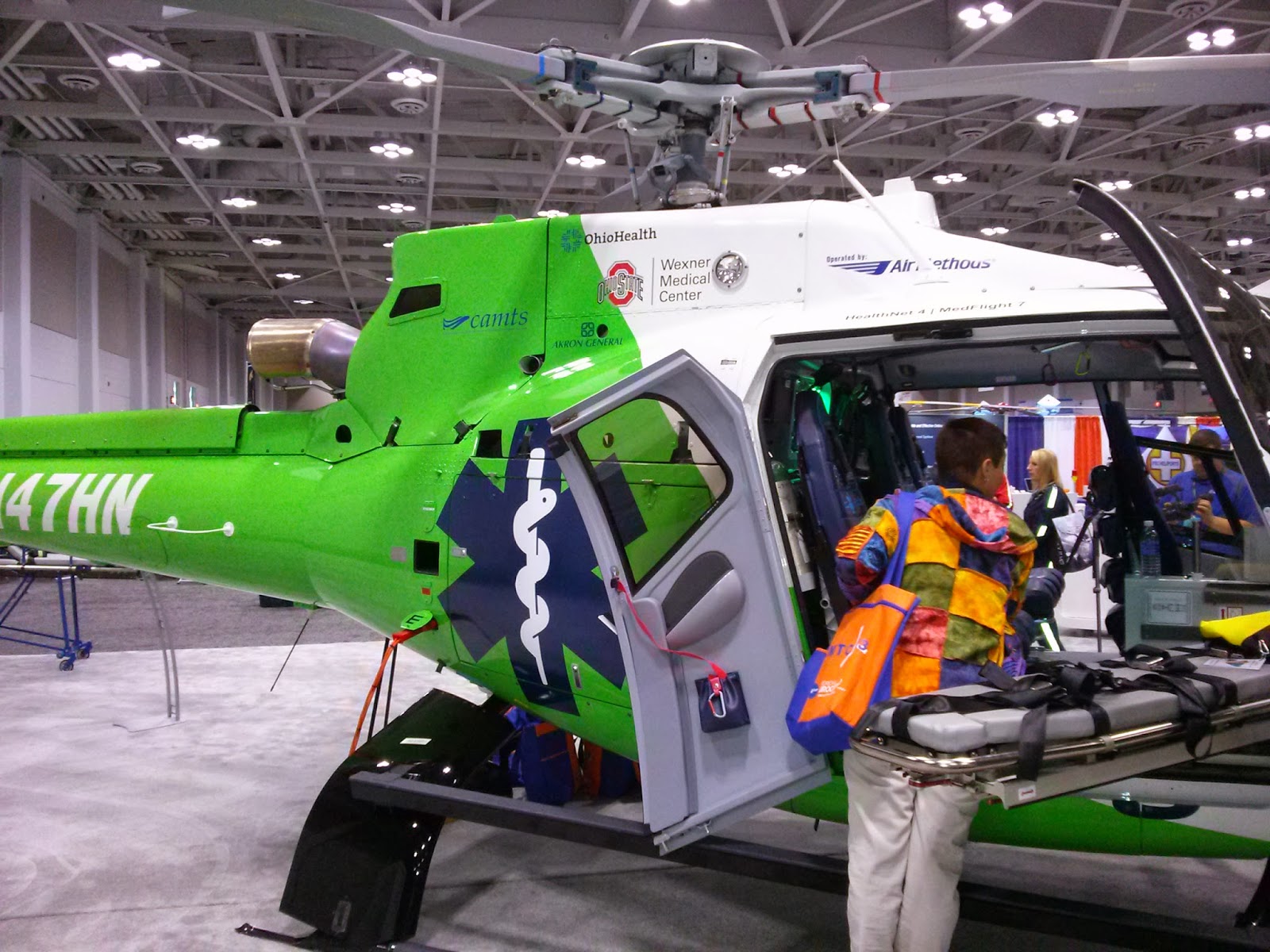
We made it home safely from AMTC. This was my first time going in over a decade, and to be honest I only went because I wanted to be a presenter, and get some exposure for my business, AMRM Training Solutions. My first impression upon entering the exhibit hall was that it was smaller than I remember it from Orlando, but that may be due to the fact that the last "show" I went to was the Heli-Expo in Houston - and it is a monster. Still, there were plenty of exhibits to see, lots of vendors, and lots of shiny new helicopters to drool over. We even got to see the new split-personality helicopter that will soon be flying sick people in West Virginia and Ohio.
Yes, there are two paint schemes on one brand new Eurocopter EC-130, the newer, fatter, tour-friendly version of the Astar. You could probably walk around the patient in that cabin, but it still only has one motor and is restricted to visual-flight-rules ( no flying in the clouds). This machine is a cooperative risk/reward sharing venture between two organizations. It is more Aerospatiale (French) than MBB (Messerschmitt-Bölkow-Blohm), with it's Starflex rotorhead (smoother in turbulence than the rigid system on the German machines) and it's Fenestron "Fan-in-Fin" shrouded tail-rotor. Pilots love it.
I saw Rick Hassman, an old friend and boss from my days with CareForce in Columbia SC, Rick is now a VP with AvstarMedia, one of the two main computer-based-training suppliers we in HEMS use. He is a genuinely decent and honest man, and AvstarMedia was lucky to get him. It was nice to see him smiling and well. I think he is drinking from the fountain of youth.
We also stopped by the booth housing RSQ911 Solutions. A great lady and RN named Kelly Hawsey is involved with this organization, and it was nice to catch up with her and hear some history of the old, original "LifeReach" program that served Columbia, South Carolina so well for so many years. They were one of the first programs that had to deal with competition with another HEMS provider setting up shop "right-next-door," and they did it with grace and professionalism.
RSQ911 Solutions provides a customized customer satisfaction survey for air and ground ambulance providers to collect feedback on their crew interactions. emsCharts has a collaborative partnership that connects our web-based patient data collection and incident reporting to RSQ911 Solutions' online survey tool. The streamlined functionality allows EMS agencies to easily connect a particular patient event to survey feedback from hospital personnel and other EMS on the scene, as well as feedback from patients and their families.
This was the year of the T-Shirt at AMTC. It seemed as if everyone except EMSFLIGHTCREW was giving them away. We have enough T-Shirts to star as Gunny Highway now - but no coozies. One savvy media company held a "put your shirt on now for a chance to win $500" event, and red shirts were everywhere. Nice work...
Golden Hour Data Systems sponsored a free beer-fest each night at a local disco-joint, and attendees took full advantage. Thank you! There were a whole bunch of blue ink-blots on the inside of right-wrists each morning, and some red eyes to go along with them. People got to let their hair down, let loose, and bond. I suspect the bonding was both vertical and horizontal - it's a conference after all.
I attended a class on high altitude EMS and rescue operations put on by a fellow who I totally misjudged on first impression. I sat down thinking he was a wacker from the sticks; I left his class thinking he was a Superman, Super-medic, and life-saving Angel for volunteering to spend two weeks on Denali at 14,000 feet living in a tent and taking care of sick people. That class was a high point of the conference.
Another high point was getting to hear General David Petraeus speak to the conference as Keynote Speaker. It was a little disappointing to find out, at literally the last second, that he wouldn't actually be "there" and instead would attend via video link. But, had he been on stage, I would have been looking at one of the two jumbo-screens anyway, so it worked fine. He spoke at length, and with humor and wisdom in equal parts. He could see us, and hear us, and took questions from the audience. I am glad the bullet that went through him during a training accident went through the "a" in Petraeus vice the A in Army... What a coincidence that the surgeon who saved his life at Vanderbilt was named Frist and would go on to fame of his own.
"The business end of a Bell"
As I said, I went to promote my business, AMRM Training Solutions, thinking that being a speaker and letting people experience my product first hand would be better (and cheaper) than renting a booth and telling them how great it is. I got the idea to be a speaker from an email that was sent out early last year asking pilots to volunteer to speak at AMTC. I did and it was a great experience, with only one extremely sad and uncomfortable moment. During my presentation, I did a case study on a fatal accident, linking it to the hazardous attitude known as get-home-itis. When I finished a fellow walked up to me, thanked me, then asked if I knew that the same program had lost another aircraft and crew that morning. Lord have Mercy. I didn't know and regret terribly choosing that crash to study - unfortunately there are plenty.
Even if you aren't interested in promoting a business, or speaking on a topic that interests you, I encourage you to attend the conference next year in Nashville if you work in HEMS.
I know a lot of HEMS pilots think AMTC is a waste of time; and primarily for clinicians. The fact is that it is our fault for not taking our place at the table. Only 17% of attendees this year were pilots, and if we won't represent ourselves who will - a non-pilot?. Anyone who has been around HEMS for awhile has something to offer, and would enjoy the experience. I watched a young communications-specialist who was as nervous as could be struggle through a class on communications. It was a good experience for him, and I learned something. I laughed out loud when Rex Alexander told me the story of the speaker he was coaching who decided at the last minute, after being "mic'ed up" for his class, that he had to use the toilet. He did so "hot mic," and returned to a room with the ice broken. Speakers receive a free night's lodging and a free registration to the show, so you get three days of edutainment for one hour of speaking. And you get to enjoy the sense of giving something back to your industry. If you don't like the way HEMS is now, here's your chance to change it.
On the last night of the show, we were having beers in the Hilton's beach side bar and grill. There are fire rings outside with seating. I noticed a group of conference-folks laughing and having a good time, and thought to myself how that picture would nicely sum up the experience of attending a conference in Virginia Beach. I finally screwed up the courage to go out and introduce myself and ask for permission to take their picture. The ladies exclaimed, "Dan - we were in your class and it was the best class in the conference!" followed up with "yes, you can take our picture." So we laughed and I said, "don't look at me, just act like you are talking and having fun. (something I learned recently from Keith Colodny who owns Precision Aerial Filmworks and is a flight medic)
This is what happens at AMTC after the days "work" is done...
I understand that if a business comes away from a conference with one or two new customers, things went well. I had a great meeting with a safety-manager from a flagship program in the northeast, and hope to spend time with them next spring. My old chief-pilot, Colin Henry, watched my presentation, and told me plainly the next morning that I will be speaking at MedFlight of Ohio next year.. So my trip was productive, and informative, and fun.
I hope to see you next year in Nashville and...
Safe Flights.
Yes, there are two paint schemes on one brand new Eurocopter EC-130, the newer, fatter, tour-friendly version of the Astar. You could probably walk around the patient in that cabin, but it still only has one motor and is restricted to visual-flight-rules ( no flying in the clouds). This machine is a cooperative risk/reward sharing venture between two organizations. It is more Aerospatiale (French) than MBB (Messerschmitt-Bölkow-Blohm), with it's Starflex rotorhead (smoother in turbulence than the rigid system on the German machines) and it's Fenestron "Fan-in-Fin" shrouded tail-rotor. Pilots love it.
I saw Rick Hassman, an old friend and boss from my days with CareForce in Columbia SC, Rick is now a VP with AvstarMedia, one of the two main computer-based-training suppliers we in HEMS use. He is a genuinely decent and honest man, and AvstarMedia was lucky to get him. It was nice to see him smiling and well. I think he is drinking from the fountain of youth.
We also stopped by the booth housing RSQ911 Solutions. A great lady and RN named Kelly Hawsey is involved with this organization, and it was nice to catch up with her and hear some history of the old, original "LifeReach" program that served Columbia, South Carolina so well for so many years. They were one of the first programs that had to deal with competition with another HEMS provider setting up shop "right-next-door," and they did it with grace and professionalism.
RSQ911 Solutions provides a customized customer satisfaction survey for air and ground ambulance providers to collect feedback on their crew interactions. emsCharts has a collaborative partnership that connects our web-based patient data collection and incident reporting to RSQ911 Solutions' online survey tool. The streamlined functionality allows EMS agencies to easily connect a particular patient event to survey feedback from hospital personnel and other EMS on the scene, as well as feedback from patients and their families.
This was the year of the T-Shirt at AMTC. It seemed as if everyone except EMSFLIGHTCREW was giving them away. We have enough T-Shirts to star as Gunny Highway now - but no coozies. One savvy media company held a "put your shirt on now for a chance to win $500" event, and red shirts were everywhere. Nice work...
Golden Hour Data Systems sponsored a free beer-fest each night at a local disco-joint, and attendees took full advantage. Thank you! There were a whole bunch of blue ink-blots on the inside of right-wrists each morning, and some red eyes to go along with them. People got to let their hair down, let loose, and bond. I suspect the bonding was both vertical and horizontal - it's a conference after all.
I attended a class on high altitude EMS and rescue operations put on by a fellow who I totally misjudged on first impression. I sat down thinking he was a wacker from the sticks; I left his class thinking he was a Superman, Super-medic, and life-saving Angel for volunteering to spend two weeks on Denali at 14,000 feet living in a tent and taking care of sick people. That class was a high point of the conference.
Another high point was getting to hear General David Petraeus speak to the conference as Keynote Speaker. It was a little disappointing to find out, at literally the last second, that he wouldn't actually be "there" and instead would attend via video link. But, had he been on stage, I would have been looking at one of the two jumbo-screens anyway, so it worked fine. He spoke at length, and with humor and wisdom in equal parts. He could see us, and hear us, and took questions from the audience. I am glad the bullet that went through him during a training accident went through the "a" in Petraeus vice the A in Army... What a coincidence that the surgeon who saved his life at Vanderbilt was named Frist and would go on to fame of his own.
"The business end of a Bell"
As I said, I went to promote my business, AMRM Training Solutions, thinking that being a speaker and letting people experience my product first hand would be better (and cheaper) than renting a booth and telling them how great it is. I got the idea to be a speaker from an email that was sent out early last year asking pilots to volunteer to speak at AMTC. I did and it was a great experience, with only one extremely sad and uncomfortable moment. During my presentation, I did a case study on a fatal accident, linking it to the hazardous attitude known as get-home-itis. When I finished a fellow walked up to me, thanked me, then asked if I knew that the same program had lost another aircraft and crew that morning. Lord have Mercy. I didn't know and regret terribly choosing that crash to study - unfortunately there are plenty.
Even if you aren't interested in promoting a business, or speaking on a topic that interests you, I encourage you to attend the conference next year in Nashville if you work in HEMS.
I know a lot of HEMS pilots think AMTC is a waste of time; and primarily for clinicians. The fact is that it is our fault for not taking our place at the table. Only 17% of attendees this year were pilots, and if we won't represent ourselves who will - a non-pilot?. Anyone who has been around HEMS for awhile has something to offer, and would enjoy the experience. I watched a young communications-specialist who was as nervous as could be struggle through a class on communications. It was a good experience for him, and I learned something. I laughed out loud when Rex Alexander told me the story of the speaker he was coaching who decided at the last minute, after being "mic'ed up" for his class, that he had to use the toilet. He did so "hot mic," and returned to a room with the ice broken. Speakers receive a free night's lodging and a free registration to the show, so you get three days of edutainment for one hour of speaking. And you get to enjoy the sense of giving something back to your industry. If you don't like the way HEMS is now, here's your chance to change it.
On the last night of the show, we were having beers in the Hilton's beach side bar and grill. There are fire rings outside with seating. I noticed a group of conference-folks laughing and having a good time, and thought to myself how that picture would nicely sum up the experience of attending a conference in Virginia Beach. I finally screwed up the courage to go out and introduce myself and ask for permission to take their picture. The ladies exclaimed, "Dan - we were in your class and it was the best class in the conference!" followed up with "yes, you can take our picture." So we laughed and I said, "don't look at me, just act like you are talking and having fun. (something I learned recently from Keith Colodny who owns Precision Aerial Filmworks and is a flight medic)
This is what happens at AMTC after the days "work" is done...
I understand that if a business comes away from a conference with one or two new customers, things went well. I had a great meeting with a safety-manager from a flagship program in the northeast, and hope to spend time with them next spring. My old chief-pilot, Colin Henry, watched my presentation, and told me plainly the next morning that I will be speaking at MedFlight of Ohio next year.. So my trip was productive, and informative, and fun.
I hope to see you next year in Nashville and...
Safe Flights.
Wednesday, October 23, 2013
Shock and Disbelief....
We are at the Air Medical Transport Conference in Virginia Beach. Yesterday morning, right after our presentation, we were told about the crash of Hospital Wing's aircraft. We send our deepest condolences to the families of those killed, and to the entire flight team. These ladies spent their working lives taking care of others. We know God has wrapped these souls in his loving arms.
God Speed friends.
God Speed friends.
Friday, October 18, 2013
BASH, BAM, BOOM: The Bird Threat
NTSB Identification: ERA14CA009
Nonscheduled 14 CFR Part 135: Air Taxi & Commuter
Accident occurred Sunday, October 20, 2013 in Madison, MS
Probable Cause Approval Date: 12/19/2013
Aircraft: EUROCOPTER AS 350 B2, registration: N911ES
Injuries: 3 Minor.
Nonscheduled 14 CFR Part 135: Air Taxi & Commuter
Accident occurred Sunday, October 20, 2013 in Madison, MS
Probable Cause Approval Date: 12/19/2013
Aircraft: EUROCOPTER AS 350 B2, registration: N911ES
Injuries: 3 Minor.
According to the pilot, he was climbing the helicopter through 1,300 feet when he felt an "explosion" in his face that knocked his visor up and affected both his visibility and crew communications. The pilot was eventually able to get his visor back down and land the helicopter, where it was discovered that both windshields were blown out, the center post and the cabin shell were damaged, the doors were blown open and on board medical equipment was missing. On the ground, a crew member stated that just before the event, he had seen a black bird fly toward the helicopter from above and left, but did not have enough time to call it out. Analysis of onboard residual bird feathers and a photograph of the suspect bird carcass indicated that it was a black vulture, which can weigh up to 4.8 pounds.
The National Transportation Safety Board determines the probable cause(s) of this accident to be:
The helicopter's collision with a black vulture during a climb to cruise altitude.
BASH (Bird Aircraft Strike Hazard)
BAM (Bird Avoidance Maneuver)
BOOM (the sound of your windshield exploding in your face - keep your visor down when possible, and your guard up always.
Fly defensively!
During shift briefings, I like to question the crew members I will be flying with about proximate threats--what will kill us today? In a single-engine helicopter, engine failure comes up a lot. In fact, a bird strike is much more likely than an engine failure and can be more deadly.
![]() |
| Bird versus Blackhawk. |
On January 4, 2009, a Sikorsky S-76 helicopter hit a Red-tailed Hawk in Louisiana. The hawk hit the helicopter just above the windscreen. The impact forced the activation of the engine fire suppression control handles, retarding the throttles and causing the engines to lose power. Eight of the nine persons on board died in the subsequent crash; the survivor, a passenger, was seriously injured
Some aircraft have plastic windshields, some have glass. The picture above makes clear that even a glass windshield will give way for a big enough bird.
"A 12-pound Canada goose struck by a 150-mph (aircraft) ... generates the kinetic energy of a 1,000-pound weight dropped from a height of 10 feet."
(Bird Strike Committee, Boeing Aero Magazine online at http://www.boeing.com/commercial/aeromagazine/articles/2011_q3/4/
During my initial training with Air Methods, we were told about a pilot who took a bird through the windshield and then suffered a loss of power from both engines! He pushed the collective down and entered autorotation. As he neared the ground, muscle memory and pattern recognition led him to sweep his hand overhead from back to front to verify that his throttles were all the way forward to the "flight" position, something he had done thousands of times as part of his before-landing checks. The bird had pushed them to the idle stop. He shoved them forward and regained power for a "normal" landing. That's a story I would rather hear than tell.
One of the hallmarks of safe flight operations is the identification of bad things that might happen, and the preparation for their eventual occurrence. We use drills, rehearsals, simulators, and table-talk to get ready for all sorts of unpleasant events, but how can we prepare for a bird coming in through the front window? Perhaps someone who has lived through it might be asked to speak at a safety meeting or group event or write his or her recollection of the event for dissemination.
Several years back Dave Andrews, a HEMS pioneer, took a bird through the windshield of a BK-117 in South Carolina. This was before pilots flying EMS wore helmets, and the bird knocked off his headset before going back out through the greenhouse (the small overhead window that allows pilots to see where they are going during a turn). He couldn't communicate with the crew in the back just then, and it must have been quite an adventure for them; waiting to find out if they were going to crash. The wind and noise in the cockpit must be disorienting. Maintaining aircraft control and slowing down are probably hard with a pounding heart and a shaking hand. I have read of crews having trouble figuring out if the blood and loose parts in their faces belong to themselves or the bird.
During the day, we can see a bird coming and make a gentle avoidance maneuver. Opinions vary on how to do that. For me, a climb usually works as most birds will tuck and dive when frightened. Some birds go into attack mode and turn into our path. Bird brains!
Striking a bird at night is a scary event for a pilot and crew. I was between Douglas Georgia and Doctor Still's burn hospital in Augusta one night at three thousand feet when we hit a big bird. The BOOM was so loud it brought the patient up out of sedation and so violent it knocked the gel-coat off the nose of our BK. Thank goodness it hit right on the knuckle of the nose. If it had hit a foot above, on the windshield, it would have been inside with us. I tasted copper in my mouth for several minutes.
After that, I began to leave the landing light on during night flights. Research on the effectiveness of this technique is mixed, but for me, it works. I haven't hit a bird since I began leaving a light on. I have always flown with my visor down since I began wearing a helmet for HEMS, but now I am flying at night with NVGs, and the only thing between my eyes and whatever comes through the windshield is a set of tubes.
Here's a bit about a more recent event. This pilot and crew were not as lucky as I and my crew were, on that flight from Douglas to Augusta.
"The helicopter was found on the bank of a reservoir on its right side on a heading about 205°... A post-impact fire consumed a majority of the fuselage... All main rotor blades remained attached to the main rotor hub. All blades were fractured in multiple locations; blade remnants and blade core pieces were found surrounding the accident site... Fragments of the pilot's night vision goggles were located in the area of the pilot controls. During the on-scene portion of the investigation, numerous geese, ducks, and cranes were observed in the reservoir and at another nearby reservoir.
Most bird strikes occur at low altitudes. Flying at or above 3000 feet AGL greatly reduces the risk of a bird strike. Birds congregate around bodies of water and trash dumps; these should be marked on hazard maps and route planning should account for these risks.
During a discussion of bird strikes with HEMS-industry safety-expert Rex Alexander, he mentioned that a company he was working with analyzed data from all their bird strikes. They found that one model of helicopter they were operating had significantly fewer strikes at night than others. They investigated what it might be about this particular model contributing to this statistic.
The answer? Those machines all have white strobes.
There is at least one vendor selling a pulsing white light as a form of bird strike protection. If you don't have one of these or white strobes, consider leaving a landing light on at night. If you aim it down at 30 to 45 degrees it doesn't totally wash out the image through your NVGs. This might save your life.
Even rocket ships hit birds.
Thursday, October 3, 2013
It's All About the Pizza...
I almost had to buy pizza for my crew two nights ago. We were standing next to our aircraft around 10 PM on a cool still night, waiting for the wheels of health care to grind. As this was my crew's third patient flight for their 24-hour shift, and my first for a 12-hour night shift, our perspectives on going to work were different. I kept my mouth shut. As we waited, I glanced up at the top of my cabin and saw a push-latch sticking up, unfastened!
"Whoa! Crap! how did I do that?" I climbed up on the step and secured it. This kind of thing happens and it's worth talking about. A few years back an incorrectly fastened latch almost killed three people. I met one of them while teaching at their program.
The aircraft had not flown all day or been removed from it's hangar. During the day shift, maintenance called and asked the duty pilot to go out and check a measurement on the fuel control linkage. He did so, and reported closing the left side cowl upon completion. When the night shift arrived, the pilot completed his preflight inspection and later in the shift the crew was alerted for a flight. They opened the hangar door and pulled the aircraft outside. When the door button was pressed to close the door, nothing happened.
Safety Briefing Topic: How does your team deal with a break in the normal sequence of events?
They talked about what to do, not wanting to pick up to a hover directly in front of an open hangar, as this would blow the place up. They decided to drag the aircraft off to the side of the ramp, away from the hangar and away from the lights. They put the tug away and all completed a walk around.
The clock was ticking and they were taking too much time.
When the engines were started, a clinician in back alerted the pilot to "a clicking sound coming from over the pilot's head." The pilot asked her to step outside and check the aircraft on the right side for anything wrong.
She did, found nothing amiss, climbed back in and they departed to the small referring hospital.
When they began a descending left turn for landing a loud BANG was heard and felt through the aircraft and then a severe shaking shuddering vibration made it difficult to fly or think. Fear impacts our ability to reason. The pilot had no idea what was wrong; only that something terrible had happened. He wasn't sure about his aircraft's condition or what to do.
He didn't think that attempting an approach to a confined area was a good idea, worrying about losing his tail rotor or an engine. He pushed the mic button and proposed flying to an airport nearby for a run-on landing.
The crew both emphatically requested landing immediately. As it turned out, that was the right choice. They suffered a cowl opening in flight.
When there is something wrong with your aircraft, will you spot it?
Fly safely friends,
HelicopterEMS.com
(edited 9/6/16, clarity, brevity)
"Whoa! Crap! how did I do that?" I climbed up on the step and secured it. This kind of thing happens and it's worth talking about. A few years back an incorrectly fastened latch almost killed three people. I met one of them while teaching at their program.
The aircraft had not flown all day or been removed from it's hangar. During the day shift, maintenance called and asked the duty pilot to go out and check a measurement on the fuel control linkage. He did so, and reported closing the left side cowl upon completion. When the night shift arrived, the pilot completed his preflight inspection and later in the shift the crew was alerted for a flight. They opened the hangar door and pulled the aircraft outside. When the door button was pressed to close the door, nothing happened.
Safety Briefing Topic: How does your team deal with a break in the normal sequence of events?
They talked about what to do, not wanting to pick up to a hover directly in front of an open hangar, as this would blow the place up. They decided to drag the aircraft off to the side of the ramp, away from the hangar and away from the lights. They put the tug away and all completed a walk around.
The clock was ticking and they were taking too much time.
When the engines were started, a clinician in back alerted the pilot to "a clicking sound coming from over the pilot's head." The pilot asked her to step outside and check the aircraft on the right side for anything wrong.
She did, found nothing amiss, climbed back in and they departed to the small referring hospital.
When they began a descending left turn for landing a loud BANG was heard and felt through the aircraft and then a severe shaking shuddering vibration made it difficult to fly or think. Fear impacts our ability to reason. The pilot had no idea what was wrong; only that something terrible had happened. He wasn't sure about his aircraft's condition or what to do.
He didn't think that attempting an approach to a confined area was a good idea, worrying about losing his tail rotor or an engine. He pushed the mic button and proposed flying to an airport nearby for a run-on landing.
The crew both emphatically requested landing immediately. As it turned out, that was the right choice. They suffered a cowl opening in flight.
Cowlings have come open many times in HEMS, with varying degrees of damage done to aircraft. The BK-117 was notorious for this, and each time a cowl came open, another fastener was added. At last count there were seven latching or locking fasteners on a BK's side cowlings; only lacking being riveted shut to make them pilot proof.
This aircraft was an EC-145 ( A BK-117C2 ) and as there wasn't much history with cowls coming open, they only had two latches. They look like this...
That cowl may or may not be latched - you cannot tell by looking at the plastic cover. The actual "latching" metal buckle is underneath the cover. The cover will not hold the cowling shut by itself.
As I am a human being, and subject to human factors; I ask my crew to help me ensure that, on OUR aircraft, the cowls are latched. To make sure they really look I took a technique from my friend Tim and like him, I have a standing offer to buy pizza for any crew member who finds a latch open on a helicopter that I am climbing into. It's a game with deadly serious consequences; I have bought once.
The crew is actively trying to catch me. The problem with a cowl opening is that when they fly up they get in the way of the action above.
Because the blades are turning so quickly, they are all invariably damaged by anything getting in the way.
In some cases the damage can destroy the structural integrity of one or more rotor blades and could result in loss of the aircraft and crew.
This almost happened to the crew in question, in fact the NTSB experts stated that had they attempted to continue flight to the nearby airport, at least one of the blades would have failed....
Remember that rotor blades experience a tremendous amount of flexing in flight, and the engineers do not add in any structural extra stuff. It's not really a "chopper." If you want to make yourself ill, watch the mast-head video of a BK blade in flight. Watch this after you finish flying for one day...
Over time, we tend to do our walk-around checks with the mental attitude that we are just confirming that all is well. This leads us to see what we want to see and miss what we should be looking for.
We need to look as if something is amiss. Have a critical eye.
Mind you, it's also not enough to simply look UP at the aircraft - we have to look down too. At the the landing gear, the grounding cable, the belly...the fuel cap!
People still take off today with the fuel cap open. It can happen to you too.
When there is something wrong with your aircraft, will you spot it?
Fly safely friends,
HelicopterEMS.com
(edited 9/6/16, clarity, brevity)
Subscribe to:
Posts (Atom)