News, safety related information, and personal experiences concerning taking care by air. All rights reserved.
pic
Monday, June 10, 2013
And yet again we grieve....
By Ian Johnston, Staff Writer, NBC News
Three people were killed when a medical helicopter crashed in Kentucky late Thursday night, officials said.
The Air Evac Lifeteam aircraft crashed in the parking lot of an elementary school at about 11:30 p.m. ET in Clay County shortly after transferring a patient to a hospital in Laurel County, NBC station WLEX-TV reported.
The school was not damaged, but a power line was hit. Witnesses said there was fog in the area at the time.
Air Evac confirmed the fatalities in a statement on its Facebook page.
“We are devastated at the loss of these crew members who we consider family,” it said.
“We have no details regarding the cause of the accident but will be working with the NTSB in coming days as they conduct their investigation,” it added.
Tuesday, June 4, 2013
The Unintended Consequences of Change....
As a new member of the HEMS community, you will undoubtedly spend some time observing how things work, and then, after you get some time behind you - and experience how things are, you will likely find yourself in a position to effect changes. I would like you to think about this, and about the effects that changes can have on people, systems, and culture. One common result of change is that there are unintended consequences. Things happen that were unforeseen, thorough-coordination ends up being not thorough enough, and some piece of the "puzzle" effected by the change that wasn't considered in advance ends up hurting someone.
Change is hard and inevitable. Every instance of change provides an opportunity for confusion, misunderstanding, and anxiety, and introduces an increased risk of catastrophe. I have too-often seen change in organizations, in practices or procedures, and in policy made for it's own sake (for some guy's resume). My caution for you is - make sure you think it through - and consider all the consequences.
My best story about the unintended consequence of change involves one of my room-mates from flight school, Pierre Desroches. There is a building with his name on it at Fort Campbell today. Pierre and I talked about our past and future lives after "lights out" at Fort Rucker in 1985; we each had separate but complementary skills at preparing our room and gear for inspections. He was a good room-mate and a good friend.. He had a background racing motorcycles, and designing high-performance exhaust systems. He had a vicious wit, an easy laugh, and took great delight in the entire flight-school experience. Well, almost all of it...
After graduation, Pierre and I crossed paths a couple of times, and not long after I volunteered for duty with B Company, 3rd Battalion, 160th Special Operations Aviation Regiment in 1989, he did the same for duty with the 160th's Chinook company at Fort Campbell. He quickly established himself as a great aviator, and was designated as an instructor in short order.
During this time, the Chinook went through an upgrade from a modified and probed D-model to a special-ops-only "Echo Model." One of the plank holders in our Savannah-based band of brothers, Terry Ledford, was tasked to participate in a users group for this new machine in '89 or early '90 - even though we would never fly one at our station. He travelled to Fort Campbell, and reported back that it was a typical fudge-cluster with everyone involved clamoring for their pet features for inclusion.
This happens also when EMS helicopters are bought - and is why no two EMS helicopters from the days of hospital-vendor relationships are configured the same.
The vendor for the Echo's cockpit avionics suite was, inexplicably, IBM. I don't know how much aviation business IBM has had over the years, and honestly I don't care. Anecdotally I can tell you that it was horrible, non-intuitive, and difficult to navigate through the pages of displayed data to obtain the information needed during a typical mission. This is not to say that the aviators at Fort Campbell didn't learn how to make the aircraft do it's job - it was just made harder than it needed to be. In case you are curious, special-ops cockpits before and since have been provided by Collins, an old aviation company, with intuitive and simple (pilot-friendly) buttons, pages, and methods of displaying data. Collins was also selected for the new conventional-forces F-Model 'hook - the Army got it right!
When I was first learning to fly on instruments, I spent time in a simple but effective UH-1 Huey flight simulator. This device had no visual "out-the-window" features, it was a straight-up instrument trainer (and a good and humbling one at that). The first phase of training is called "B-I" or basic instruments, and teaches a pilot how to maintain control of the aircraft solely by reference to an assortment of - at the time - analog dials and gauges. The one nuggets lean on the most at first is the attitude indicator, or artificial horizon. This because the little earth-and-sky depiction is closest to what the pilot would be looking at if he or she could see out the window. Push the stick forward and you are looking at brown (headed for the dirt), pull back and you see more blue (sky), keep the "wings" level and you avoid a failing-grade slip - or worse, an audience with your angels. The tricky thing about the attitude indicator, or at least it was initially tricky to me, is that when you roll the aircraft into a turn, the "ball" or earth-sky representation appears to roll the opposite direction. This makes perfect sense of course, because when we roll an aircraft, the view out the windshield shows the earth maintaining it's position and us changing attitude. The orange triangle or "bank index" in the picture below, likewise moves in the opposite direction to the direction of roll. I screwed this up more than once when I was new, beginning a turn, looking at the index and seeing it go the "wrong" way, and jerking the cyclic stick back the other way. Time and training taught me how to correctly interpret the information being provided. And every other pilot before and since who has flown by reference to an attitude indicator.
Here is a view looking down upon the panel in the left side of the Chinook cockpit. The right side panel looks the same.
Change is hard and inevitable. Every instance of change provides an opportunity for confusion, misunderstanding, and anxiety, and introduces an increased risk of catastrophe. I have too-often seen change in organizations, in practices or procedures, and in policy made for it's own sake (for some guy's resume). My caution for you is - make sure you think it through - and consider all the consequences.
My best story about the unintended consequence of change involves one of my room-mates from flight school, Pierre Desroches. There is a building with his name on it at Fort Campbell today. Pierre and I talked about our past and future lives after "lights out" at Fort Rucker in 1985; we each had separate but complementary skills at preparing our room and gear for inspections. He was a good room-mate and a good friend.. He had a background racing motorcycles, and designing high-performance exhaust systems. He had a vicious wit, an easy laugh, and took great delight in the entire flight-school experience. Well, almost all of it...
After graduation, Pierre and I crossed paths a couple of times, and not long after I volunteered for duty with B Company, 3rd Battalion, 160th Special Operations Aviation Regiment in 1989, he did the same for duty with the 160th's Chinook company at Fort Campbell. He quickly established himself as a great aviator, and was designated as an instructor in short order.
During this time, the Chinook went through an upgrade from a modified and probed D-model to a special-ops-only "Echo Model." One of the plank holders in our Savannah-based band of brothers, Terry Ledford, was tasked to participate in a users group for this new machine in '89 or early '90 - even though we would never fly one at our station. He travelled to Fort Campbell, and reported back that it was a typical fudge-cluster with everyone involved clamoring for their pet features for inclusion.
This happens also when EMS helicopters are bought - and is why no two EMS helicopters from the days of hospital-vendor relationships are configured the same.
The vendor for the Echo's cockpit avionics suite was, inexplicably, IBM. I don't know how much aviation business IBM has had over the years, and honestly I don't care. Anecdotally I can tell you that it was horrible, non-intuitive, and difficult to navigate through the pages of displayed data to obtain the information needed during a typical mission. This is not to say that the aviators at Fort Campbell didn't learn how to make the aircraft do it's job - it was just made harder than it needed to be. In case you are curious, special-ops cockpits before and since have been provided by Collins, an old aviation company, with intuitive and simple (pilot-friendly) buttons, pages, and methods of displaying data. Collins was also selected for the new conventional-forces F-Model 'hook - the Army got it right!
When I was first learning to fly on instruments, I spent time in a simple but effective UH-1 Huey flight simulator. This device had no visual "out-the-window" features, it was a straight-up instrument trainer (and a good and humbling one at that). The first phase of training is called "B-I" or basic instruments, and teaches a pilot how to maintain control of the aircraft solely by reference to an assortment of - at the time - analog dials and gauges. The one nuggets lean on the most at first is the attitude indicator, or artificial horizon. This because the little earth-and-sky depiction is closest to what the pilot would be looking at if he or she could see out the window. Push the stick forward and you are looking at brown (headed for the dirt), pull back and you see more blue (sky), keep the "wings" level and you avoid a failing-grade slip - or worse, an audience with your angels. The tricky thing about the attitude indicator, or at least it was initially tricky to me, is that when you roll the aircraft into a turn, the "ball" or earth-sky representation appears to roll the opposite direction. This makes perfect sense of course, because when we roll an aircraft, the view out the windshield shows the earth maintaining it's position and us changing attitude. The orange triangle or "bank index" in the picture below, likewise moves in the opposite direction to the direction of roll. I screwed this up more than once when I was new, beginning a turn, looking at the index and seeing it go the "wrong" way, and jerking the cyclic stick back the other way. Time and training taught me how to correctly interpret the information being provided. And every other pilot before and since who has flown by reference to an attitude indicator.
Still with me? Great! So as the guys from IBM, in coordination with the end-users advisory group are designing the Echo Model Chinook's cockpit and deciding how to write the software, legend has it that one smart fellow decides "hey! we're talking digital here and we can provide information any way we want!" They decided to have the horizon representation-line on the rectangular cathode-ray-tube (CRT) multi-function-display (MFD) maintain it's relationship to the actual horizon during a turn.
And then, in a poorly thought-out change, they decided that it made more sense if the bank-index rolled the same way that the aircraft was banking, instead of moving opposite to direction of roll - the way every attitude indicator ever made has worked. This simple little choice killed Pierre Desroches, Wally Fox, and an enlisted crew: as well as a young aviator who was being given an special-ops assessment-flight check ride one night near Fort Campbell. Of course the Army and the 160th guys conducted an investigation into the crash. They involved the wizards from the regiment's systems-integration-management-office (SIMO) and set about sorting things out. They officially decided that the cause of the crash was rainwater or snowmelt getting into the electrical bus bars (large volume circuit-breakers) located on the power distribution panels near the floor on the cockpit sidewalls through leaking side-window seals; shorting out the aircraft's entire electrical system, resulting in a complete electrical failure and total loss of all cockpit instrument displays. Notwithstanding the fact the the bus bars have a bus-tie-disconnect feature that effectively cuts the aircraft's electrical system in half (left versus right) if a problem such as a short-circuit occurs on one side or the other - providing the required system redundancy for instrument flight. The SIMO guys, with straight faces, explained that the short-circuit was hair-trigger fast and managed to fail both electrical systems before the bus-tie feature could snap open leaving one generator to keep some of the lights on. Either that or water somehow entered both side panels at exactly the same instant failing both in unison...
That dog doesn't hunt.
Here is a view looking down upon the panel in the left side of the Chinook cockpit. The right side panel looks the same.
Occam's razor (also written as Ockham's razor from William of Ockham, and in Latin lex parsimoniae) is a principle of parsimony, economy, or succinctness used in logic and problem-solving. It states that among competing hypotheses, the hypothesis with the fewest assumptions should be selected. (wikipedia)
Chinook electrical bus-bars and power-distribution-panels have been located in the same place since the A-model. Chinooks have flown through many rain storms, and window seals have been leaking since SN 001 rolled out of Philly. I myself spent 3500 hours flying the aircraft, through all kinds of weather, and had all kinds of leaks. I study, teach, and spend countless hours thinking about human-factors acccidents, and this crash was a classic human-factors event related to the unintended consequence of change. The pilot being assessed was familiar with flying a military version of the Bell JetRanger (an OH-58), with anolog instruments, much less information to digest from the displays, and a tried-and-true mechanical attitude indicator. He was being radar-vectored for an instrument approach to Fort Campbell as his check ride was being completed, and was instructed to make a turn. The bewildering amount of data available to him overwhelmed him - to be fair he was not familiar with the MFDs - and when he got confused his eyes found the electrical symbol on the CRT that represented the bank index, and it went the wrong way.
The 160th stopped letting pilots being assessed fly the Echo Model after this crash. Even though rain water and a short circuit caused it... That's what is in the accident report.
The crash was caused because someone decided to change something, and no one anticipated that a guy who wasn't a frequent instrument flyer who was unfamiliar with the cockpit layout and displays, would fall back on what he thought was the simplest and most reliable source for turn information, the bank index.
Considering change in your organization? Think it through. Get every smart person available in one room, and war-game the change to death. So that the result avoids it....
Tuesday, April 23, 2013
Excellence and Humility...The Perfect Couple
John Leduc is one of my favorite aviation heroes, up there with Yeager, and Gann, and David Sparkman. You probably have never heard of John, but I assure you that you know of his work - because he has been producing 160th SOAR NightStalker pilots for decades. First as a military instructor pilot, and later as a civilian contractor-instructor. He almost single-handedly wrote the standard-operating-procedure that the Chinook units in the 160th were using when I was there.
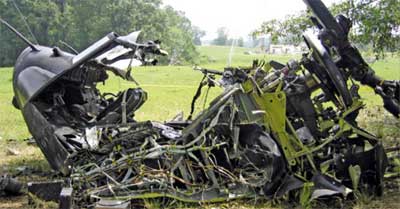
John embodies the concept of the "quiet professional" which is what special operators are supposed to be. John's nickname is "Lucky" because he once flew a Chinook all the way to Honduras from the US, overwater, and had it eat itself for lunch right after landing at the airport. He told me that when the aircraft started coming apart, he immediately reached for the throttles on the center console. Except they weren't there - he had transitioned into a D-Model Chinook from the C-Model. The throttles had been moved to the overhead console. He realized his mistake and reached up, and by the time his hand got to where the throttles were supposed to be, they were gone. The top of the cockpit was torn off by the crashing forward transmission and rotor system. It looked something like this.
On Johns ship, everyone lived.
Lucky.
John taught me to operate the MH-47D Model, with a cockpit that was state of the art in it's day. The aircraft had a strap-down inertial guidance system, a doppler-navigation computer using four beam-legs to derive distance and direction from a known start-point, and an early GPS; all sending position estimations to a mission computer. John would fail the devices one at a time and watch us go through the degraded system procedures, until we were reduced to the hand-held map. He liked to mention that we were pigs in space.
The other thing that set the aircraft apart from other Chinooks was the big black tube sticking out from the nose; the aerial refueling probe. After much experimentation, the 160th selected a probe length that ended six feet or so inside the tip path plane of the spinning forward rotor blades - the only such arrangement on any helicopter in the world.
A Chinook pilot has to run the aircraft's forward rotor up over the bobbing paradrogue, which creates it's own hazardous situation and makes a blade strike occur all too easy. John is a masterful pilot, and can stick the probe tip into the center of the drogue ring every time. But that's not what he did when he took Tommy Pequeno and I out for our first jousting match.
On that sunny day over southeast Georgia, when he was demonstrating aerial refueling, and the windshield was completely covered with airplane RIGHT THERE, he calmly described every step of the task, from observing the C-130 at a safe distance, to the move down and into the pre-contact position with the probe-tip 10 to 15 feet behind the paradroque (which moves around on the best day and taunts you in turbulence to "come and get me if you can"), the acquisition of vertical and lateral visual cues (the amount of wing underside visible while looking up underneath the lowered wing flaps, and the position of the refueling pod's vertical pylon/strut against the flaps side edge), and finally the announcement, "moving to contact."
(This is what AR looks like from the airplane crews perspective. Another form of intubation.)
I bet my eyes got wide as we closed the 10 feet with a 4 knot closure rate, and then he did it - he missed the drogue. The probe tip caressed the white fabric of the inflated ring and slid past it at the ten o'clock position. Neither Tommy nor I could speak, so John announced a "miss" and slid the aircraft left and up until we were looking straight into the dump tube at the outer end of the -130's wing. "Okay, you have the controls."
Now, if you have been thinking, you realize how masterful that simple little training technique was. A pilot looking at a refueling paradrogue eye-to-eye for the first time is going to be a bit apprehensive, and will probably grip the controls more firmly than normal. His arm mucles will tense up and affect control touch - and bring on a case of the jerks which is a bad thing up near an airplane. The intentional miss decompresses the situation, and makes the student relax - "heck if he can miss so can I..."
If you ask John, he would tell you that he can miss the paradrogue on any given night.
This is but one example of John Leduc's humility. He is an expert, an aviation MASTER, but you would never know it to talk with him. More than most, he knows what part luck plays in a successful flying career. You can do everything right and still come up short. From this knowledge springs humility.
John has passed on more knowledge than most instructors, and often the beneficiary doesn't even know he is being instructed - he just thinks he is engaged in a friendly conversation. John quietly stays at the top of his game, and freely gives away everything he has to offer. He leads by example.
We should be such people.
We should never stop trying to improve our skills, and our knowledge of our craft. Sure, the mission can become routine, and years of experience can dull the desire for self-improvement, and we don't make that much money, and blah blah blah.... We are pilots! People depend on us to do the right thing every time - even if we are retiring in a week or two. When we screw up, it affects how the world looks at all of us. I like a line from a recent Vertical Magazine article, "keep your moral compass pointing north." It ain't always easy, but it's right. Constant self-improvement need not be overwhelming. While waiting for a crew to return from dropping off a patient at a receiving facility is an excellent time to turn on the battery, test the caution panel, and find out if you know what to in the event of each of those segments illuminating. You don't have to tackle them all at once - but do a couple each flight. Pull out the flight manual and review a limitation or two. If your attainment of aviation knowlege has devolved to the CTS or AVSTAR training we do each month or quarter, make yourself a list of all the books you should be familiar with, and give 15 or 20 minutes a day for rediscovery. AOPA has free online training segments that take only a few minutes each, and serve to refresh understanding of stuff we forgot years ago.
When I went to the Army's instructor pilot course, the IP handbook was a slim green-covered paperback that some instructor wrote as part of his advanced degree training. I will never forget the admonition inside the cover, "Be gentle to man and machine."
It is not the mark of excellence to demonstrate how aggressively you can manouver a helicopter. If you think that such skills are important, ask your examiner about it when taking a checkride. Our crewmembers and passengers should consider us to be boring pilots, who simply go up - over - and - down. (If you are a crewmember, and your pilot is thrilling you, be aware that he or she may end up killing you and for God's sake don't ask for it). Any idiot can crank a helicopter around the sky doing whifferdills, and you can only tie the record for flying low. The mark of an excellent pilot is one who uses only as much aircraft as he or she must to get the job done.
That's it. A little bit of continuous self-improvement, a daily dose of self-discipline, and a dash of humility, and you too can be like John Leduc....
John embodies the concept of the "quiet professional" which is what special operators are supposed to be. John's nickname is "Lucky" because he once flew a Chinook all the way to Honduras from the US, overwater, and had it eat itself for lunch right after landing at the airport. He told me that when the aircraft started coming apart, he immediately reached for the throttles on the center console. Except they weren't there - he had transitioned into a D-Model Chinook from the C-Model. The throttles had been moved to the overhead console. He realized his mistake and reached up, and by the time his hand got to where the throttles were supposed to be, they were gone. The top of the cockpit was torn off by the crashing forward transmission and rotor system. It looked something like this.
On Johns ship, everyone lived.
Lucky.
John taught me to operate the MH-47D Model, with a cockpit that was state of the art in it's day. The aircraft had a strap-down inertial guidance system, a doppler-navigation computer using four beam-legs to derive distance and direction from a known start-point, and an early GPS; all sending position estimations to a mission computer. John would fail the devices one at a time and watch us go through the degraded system procedures, until we were reduced to the hand-held map. He liked to mention that we were pigs in space.
The other thing that set the aircraft apart from other Chinooks was the big black tube sticking out from the nose; the aerial refueling probe. After much experimentation, the 160th selected a probe length that ended six feet or so inside the tip path plane of the spinning forward rotor blades - the only such arrangement on any helicopter in the world.
A Chinook pilot has to run the aircraft's forward rotor up over the bobbing paradrogue, which creates it's own hazardous situation and makes a blade strike occur all too easy. John is a masterful pilot, and can stick the probe tip into the center of the drogue ring every time. But that's not what he did when he took Tommy Pequeno and I out for our first jousting match.
On that sunny day over southeast Georgia, when he was demonstrating aerial refueling, and the windshield was completely covered with airplane RIGHT THERE, he calmly described every step of the task, from observing the C-130 at a safe distance, to the move down and into the pre-contact position with the probe-tip 10 to 15 feet behind the paradroque (which moves around on the best day and taunts you in turbulence to "come and get me if you can"), the acquisition of vertical and lateral visual cues (the amount of wing underside visible while looking up underneath the lowered wing flaps, and the position of the refueling pod's vertical pylon/strut against the flaps side edge), and finally the announcement, "moving to contact."
(This is what AR looks like from the airplane crews perspective. Another form of intubation.)
I bet my eyes got wide as we closed the 10 feet with a 4 knot closure rate, and then he did it - he missed the drogue. The probe tip caressed the white fabric of the inflated ring and slid past it at the ten o'clock position. Neither Tommy nor I could speak, so John announced a "miss" and slid the aircraft left and up until we were looking straight into the dump tube at the outer end of the -130's wing. "Okay, you have the controls."
Now, if you have been thinking, you realize how masterful that simple little training technique was. A pilot looking at a refueling paradrogue eye-to-eye for the first time is going to be a bit apprehensive, and will probably grip the controls more firmly than normal. His arm mucles will tense up and affect control touch - and bring on a case of the jerks which is a bad thing up near an airplane. The intentional miss decompresses the situation, and makes the student relax - "heck if he can miss so can I..."
If you ask John, he would tell you that he can miss the paradrogue on any given night.
This is but one example of John Leduc's humility. He is an expert, an aviation MASTER, but you would never know it to talk with him. More than most, he knows what part luck plays in a successful flying career. You can do everything right and still come up short. From this knowledge springs humility.
John has passed on more knowledge than most instructors, and often the beneficiary doesn't even know he is being instructed - he just thinks he is engaged in a friendly conversation. John quietly stays at the top of his game, and freely gives away everything he has to offer. He leads by example.
We should be such people.
We should never stop trying to improve our skills, and our knowledge of our craft. Sure, the mission can become routine, and years of experience can dull the desire for self-improvement, and we don't make that much money, and blah blah blah.... We are pilots! People depend on us to do the right thing every time - even if we are retiring in a week or two. When we screw up, it affects how the world looks at all of us. I like a line from a recent Vertical Magazine article, "keep your moral compass pointing north." It ain't always easy, but it's right. Constant self-improvement need not be overwhelming. While waiting for a crew to return from dropping off a patient at a receiving facility is an excellent time to turn on the battery, test the caution panel, and find out if you know what to in the event of each of those segments illuminating. You don't have to tackle them all at once - but do a couple each flight. Pull out the flight manual and review a limitation or two. If your attainment of aviation knowlege has devolved to the CTS or AVSTAR training we do each month or quarter, make yourself a list of all the books you should be familiar with, and give 15 or 20 minutes a day for rediscovery. AOPA has free online training segments that take only a few minutes each, and serve to refresh understanding of stuff we forgot years ago.
When I went to the Army's instructor pilot course, the IP handbook was a slim green-covered paperback that some instructor wrote as part of his advanced degree training. I will never forget the admonition inside the cover, "Be gentle to man and machine."
It is not the mark of excellence to demonstrate how aggressively you can manouver a helicopter. If you think that such skills are important, ask your examiner about it when taking a checkride. Our crewmembers and passengers should consider us to be boring pilots, who simply go up - over - and - down. (If you are a crewmember, and your pilot is thrilling you, be aware that he or she may end up killing you and for God's sake don't ask for it). Any idiot can crank a helicopter around the sky doing whifferdills, and you can only tie the record for flying low. The mark of an excellent pilot is one who uses only as much aircraft as he or she must to get the job done.
That's it. A little bit of continuous self-improvement, a daily dose of self-discipline, and a dash of humility, and you too can be like John Leduc....
Monday, April 22, 2013
Preaching the Gospel....
Like most of us, I have lost many friends to helicopter crashes over the years. Some losses hit harder than others; some cut right to the bone. My first brush with tragedy took place in Honduras in 1988. We had flown an aircraft down from Fort Bragg, other crews joined us out of Hunter Army Airfield in Savannah. Personalities being what they are, one of the Warrant Officer pilots from Hunter decided that he wasn't going to fly with his platoon leader another day, and announced a crew change over beers while watching the enlisted guys play volleyball.
As my LT. Alan Urban was an agreeable sort, and my crew was, well, my crew, I protested the change. The trip officer-in-charge laughed about all this and said, "well Mr. Foulds, it looks like Randy has pulled rank on you (he was a -3, I was a -2). The next day Randy Potter took my helicopter, my platoon leader, and my crew, and flew off to the north.
I went south with his crew and the aforementioned Captain. While finishing up some work at Tiger Island, we got a call from HQ asking about our status and position. They instructed us to return to base immediately. My aircraft, without me on board, had crashed. Everyone was dead. It was hard.
Gravity waits patiently for technology to fail.
A few years later, a crew I knew well flew into a tower in Iraq. The wife of a fellow Nightstalker was on board, and while it shouldn't matter that it was a pretty young girl named Marie Rossi versus a guy who died in that seat - along with everyone else on board - it did. It was devastating.
Not long after that, my room-mate from flight school, Pierre Desroches, was performing an assessment on a candidate for duty in the 160th. Riding along with Pierre and the assessee was the smartest Chinook pilot I ever met, Wally Fox. After having the assessee perform an NVG route to an objective, they were returning to Campbell Army Airfield, and setting up for a practice instrument approach. Campbell approach control gave them a vector towards the airport, and the aircraft fell to the earth - all aboard were killed. This was a human-factors crash, involving instrument design and information display, but that's a story for another day.
Then Curt, a young officer I met through a friend - and who stayed at my house with his girlfriend - and an entire crew flew into the water near the Philippines. I heard that Curt's voice was on the recorder, calmly calling out the radar altitude from the jump seat as the aircraft descended to it's destruction. That crash took a lot of old legends, and young Curt Feistner who threw hoops with my sons.
And then there was the battle loss of a friend that I assessed myself, and was hard on. Chris Scherkenbach and I were buddies, and when he volunteered, and I assessed him, and determined that his performance was sub-standard, it put me in an uncomfortable position. And he got reamed by the board. Then he turned himself into one of the most squared-away Warrant Officers ever. But that didn't keep him from getting shot down and killed with his crew on a hilltop in Afghanistan while trying to rescue a SEAL team in trouble.
By this point, I had become a little bit numb about Chinook crashes. And fatalistic; as in, if it's gonna happen it's gonna happen and there is nothing I can do about it. I was now flying EMS helicopters, and they fell out of the sky just as readily as the army ships had.
We figured out the hard way that a visual-flight-rules helo has no business flying into the clouds at low level at night (or during the day for that matter), or into icing conditions (a lesson that must be relearned periodically). We also learned that you should not disconnect a warning light in the field and attempt to fly the aircraft back to the base after - by the Grace of God - sending the crew and patient by ground. A poor fellow and his crew in Texas proved that the tension/torsion strap-packs that hold BK blades on aren't really lifetime parts after all. He was the age then that I am now, and I think about him often. We learn lessons, and forget them, and people keep dying.
And then there was Pat. When he and his crew flew into a storm near Georgetown, SC in 2009, and my wife, a nurse on the Lifestar ship in Savannah, came home and woke me up to tell me about it, I got mad.
I thought, Enough Already! Then I decided to do something. I started travelling around the country for my company and talking to people about what causes these accidents. You see, in most cases it's possible to determine what was going on, even without the benefit of a voice-recorder which airplanes have and helicopters should. It's usually one or a few of the same old things over and over again. So I talk to crews, and we study accidents and look for patterns. I want them to be able to recognize a pattern when they are in one, and stop it. I know that Earnest K. Gann told us that "Fate is the Hunter", and to be sure, there is an element of luck in all this - but I believe we can often make our own luck.
I started teaching AMRM with the Lifeline crews in Indiana, when Pat's crash was still a raw scar on my psyche; to the point that I would have to stop talking and collect myself. Pat took a risk, but Diana and Claxton were just along for the ride, and didn't know what to say, or what questions to ask. It was during one of these pauses for self-collection that a soft voice in the room spoke - "keep preaching the gospel brother." Yes ma'am. I will. I never forget that maybe - just maybe - someone in the room with me is going to prevent the next big crash - if - I can say the right words in the right way, and convey understanding. I show people what happens when we turn our backs on common sense and conventional wisdom.
Rooms become very quiet during these discussions of warm, living, loving people coming to a massive crashing end. And most people understand. Some pilots want medical crew members to get in, sit back, and shut up. These attitudes are shaped by experience, and lead to inappropriate behavours. While I would hope that a pilot could buy into the tenets of crew-resource management, I would also hope that the crewmembers would as well. There are bad apples in all the baskets.
Way back in 1985 I was taught the real meaning of crew-resource management and crew coordination by smart, kind, wise chinook crew-chiefs and flight engineers. These guys knew a lot about helicopters, and pilots, and they would take the time to impart wisdom to keep us all alive.
(Believe it or not, in many cases when a Chinook is doing it's mission, the pilot is following the instructions of the crew chief, who is where the work is being done. This experience breaks down the pilot-crew barrier very well, and creates a synergistic effect.)
In our industry, there are a lot of smart people flying in EMS helicopters. And some trouble-makers. A challenge for leaders is to determine who is causing trouble, straighten them out, or show them the door. Yes this is hard, yes this takes work, and if you are a leader this is your job. Trust me, it's better than answering questions from the media about your recent fatal accident...
The challenge for all of us is to re-dedicate ourselves to being and doing our best, every shift, so that we don't become the topic of someone else's safety briefing. Safe operations depend on effective crew coordination (enhanced by teamwork), situational awareness (enhanced by teamwork), appropriate monitoring and checking (enhanced by teamwork), and the identification and elimination of inappropriate attitudes (enhanced by teamwork). Do you see a pattern?
Using all the brains available only makes sense, and the answer to a problem can come from an unexpected source. Sometimes the dumbest person in the room saves the day...
Anyway, if you are still with me, thanks. I have been granted the privilege of an opportunity to make my case as a presenter at the next Air Medical Transport Conference, to be held this October in Virginia Beach.
If you fly sick people to the hospital, I hope to see you there, smiling and well. Together, we can fix this.
As my LT. Alan Urban was an agreeable sort, and my crew was, well, my crew, I protested the change. The trip officer-in-charge laughed about all this and said, "well Mr. Foulds, it looks like Randy has pulled rank on you (he was a -3, I was a -2). The next day Randy Potter took my helicopter, my platoon leader, and my crew, and flew off to the north.
I went south with his crew and the aforementioned Captain. While finishing up some work at Tiger Island, we got a call from HQ asking about our status and position. They instructed us to return to base immediately. My aircraft, without me on board, had crashed. Everyone was dead. It was hard.
Gravity waits patiently for technology to fail.
A few years later, a crew I knew well flew into a tower in Iraq. The wife of a fellow Nightstalker was on board, and while it shouldn't matter that it was a pretty young girl named Marie Rossi versus a guy who died in that seat - along with everyone else on board - it did. It was devastating.
Not long after that, my room-mate from flight school, Pierre Desroches, was performing an assessment on a candidate for duty in the 160th. Riding along with Pierre and the assessee was the smartest Chinook pilot I ever met, Wally Fox. After having the assessee perform an NVG route to an objective, they were returning to Campbell Army Airfield, and setting up for a practice instrument approach. Campbell approach control gave them a vector towards the airport, and the aircraft fell to the earth - all aboard were killed. This was a human-factors crash, involving instrument design and information display, but that's a story for another day.
Then Curt, a young officer I met through a friend - and who stayed at my house with his girlfriend - and an entire crew flew into the water near the Philippines. I heard that Curt's voice was on the recorder, calmly calling out the radar altitude from the jump seat as the aircraft descended to it's destruction. That crash took a lot of old legends, and young Curt Feistner who threw hoops with my sons.
And then there was the battle loss of a friend that I assessed myself, and was hard on. Chris Scherkenbach and I were buddies, and when he volunteered, and I assessed him, and determined that his performance was sub-standard, it put me in an uncomfortable position. And he got reamed by the board. Then he turned himself into one of the most squared-away Warrant Officers ever. But that didn't keep him from getting shot down and killed with his crew on a hilltop in Afghanistan while trying to rescue a SEAL team in trouble.
By this point, I had become a little bit numb about Chinook crashes. And fatalistic; as in, if it's gonna happen it's gonna happen and there is nothing I can do about it. I was now flying EMS helicopters, and they fell out of the sky just as readily as the army ships had.
We figured out the hard way that a visual-flight-rules helo has no business flying into the clouds at low level at night (or during the day for that matter), or into icing conditions (a lesson that must be relearned periodically). We also learned that you should not disconnect a warning light in the field and attempt to fly the aircraft back to the base after - by the Grace of God - sending the crew and patient by ground. A poor fellow and his crew in Texas proved that the tension/torsion strap-packs that hold BK blades on aren't really lifetime parts after all. He was the age then that I am now, and I think about him often. We learn lessons, and forget them, and people keep dying.
And then there was Pat. When he and his crew flew into a storm near Georgetown, SC in 2009, and my wife, a nurse on the Lifestar ship in Savannah, came home and woke me up to tell me about it, I got mad.
I thought, Enough Already! Then I decided to do something. I started travelling around the country for my company and talking to people about what causes these accidents. You see, in most cases it's possible to determine what was going on, even without the benefit of a voice-recorder which airplanes have and helicopters should. It's usually one or a few of the same old things over and over again. So I talk to crews, and we study accidents and look for patterns. I want them to be able to recognize a pattern when they are in one, and stop it. I know that Earnest K. Gann told us that "Fate is the Hunter", and to be sure, there is an element of luck in all this - but I believe we can often make our own luck.
I started teaching AMRM with the Lifeline crews in Indiana, when Pat's crash was still a raw scar on my psyche; to the point that I would have to stop talking and collect myself. Pat took a risk, but Diana and Claxton were just along for the ride, and didn't know what to say, or what questions to ask. It was during one of these pauses for self-collection that a soft voice in the room spoke - "keep preaching the gospel brother." Yes ma'am. I will. I never forget that maybe - just maybe - someone in the room with me is going to prevent the next big crash - if - I can say the right words in the right way, and convey understanding. I show people what happens when we turn our backs on common sense and conventional wisdom.
Rooms become very quiet during these discussions of warm, living, loving people coming to a massive crashing end. And most people understand. Some pilots want medical crew members to get in, sit back, and shut up. These attitudes are shaped by experience, and lead to inappropriate behavours. While I would hope that a pilot could buy into the tenets of crew-resource management, I would also hope that the crewmembers would as well. There are bad apples in all the baskets.
Way back in 1985 I was taught the real meaning of crew-resource management and crew coordination by smart, kind, wise chinook crew-chiefs and flight engineers. These guys knew a lot about helicopters, and pilots, and they would take the time to impart wisdom to keep us all alive.
(Believe it or not, in many cases when a Chinook is doing it's mission, the pilot is following the instructions of the crew chief, who is where the work is being done. This experience breaks down the pilot-crew barrier very well, and creates a synergistic effect.)
In our industry, there are a lot of smart people flying in EMS helicopters. And some trouble-makers. A challenge for leaders is to determine who is causing trouble, straighten them out, or show them the door. Yes this is hard, yes this takes work, and if you are a leader this is your job. Trust me, it's better than answering questions from the media about your recent fatal accident...
The challenge for all of us is to re-dedicate ourselves to being and doing our best, every shift, so that we don't become the topic of someone else's safety briefing. Safe operations depend on effective crew coordination (enhanced by teamwork), situational awareness (enhanced by teamwork), appropriate monitoring and checking (enhanced by teamwork), and the identification and elimination of inappropriate attitudes (enhanced by teamwork). Do you see a pattern?
Using all the brains available only makes sense, and the answer to a problem can come from an unexpected source. Sometimes the dumbest person in the room saves the day...
Anyway, if you are still with me, thanks. I have been granted the privilege of an opportunity to make my case as a presenter at the next Air Medical Transport Conference, to be held this October in Virginia Beach.
If you fly sick people to the hospital, I hope to see you there, smiling and well. Together, we can fix this.
Monday, April 8, 2013
Hello Dolly!
After a smooth scene flight yesterday, I flew my crew from Palm Beach back to the Martin County Fire Rescue hangar at the Stuart, FL Airport; where I am filling in this week.
We enjoyed the scenery coming up the coast, and were cleared to land upon initial contact with the tower. As I eased the aircraft toward the landing dolly (a wheeled platform used to move skid-gear helicopters into and out of hangars),I spoke into the microphone, "it's all over now but the dolly landing." I then set about relaxing for the task at hand.
One of the crewmember's said, "oh, yeah, the good old dolly. Both of them mentioned that they would be happy to have me land on the cement and let them out before the airshow, if there was going to be one.
I scared myself silly 15 years ago while performing a power check in a BK at the Geisinger Medical Center in Danville PA. I had the stupid idea that I could perform this check - in which the aircraft is brought light on it's skids using power from one motor at a time and instrument parameters are recorded - by myself; without bothering to reposition to the soft, forgiving sod. So I was the sod when, just as I was writing the turbine temperature on a notepad, my BK decided that the rotor torque-to-tailrotor thrust ratio was unbalanced and the friction between skids and wood planks was nil. The aircraft jerked in the yaw axis and shifted on the platform, which had become suddenly and alarmingly small. I dropped the pen and pushed down on the collective to stop the motion, and luckily did not fall off the dolly in a 4 million dollar helicopter.
We enjoyed the scenery coming up the coast, and were cleared to land upon initial contact with the tower. As I eased the aircraft toward the landing dolly (a wheeled platform used to move skid-gear helicopters into and out of hangars),I spoke into the microphone, "it's all over now but the dolly landing." I then set about relaxing for the task at hand.
One of the crewmember's said, "oh, yeah, the good old dolly. Both of them mentioned that they would be happy to have me land on the cement and let them out before the airshow, if there was going to be one.
Dolly landings have vexed more than one pilot, and led to some spectacular crashes.
This gentleman fell prey to the hazardous attitude known as "impulsivity", or the overwhelming urge, when faced with a challenging situation, to do something right now. Action without thought, especially when distracted or upset, often makes a bad situation worse. It's much better to hold-up, stop, and think.
He bounced laterally, and got one skid on the ground, he was probably upset and embarrassed, (I would be too) and felt the need for an immediate corrective response. Imagine though, if he had simply stopped at that point, with the aircraft half on and half off the dolly...
Some operators refuse to use dollies, citing the risks involved. (sometimes they are simply undercapitalized, and don't worry about what the crews have to put up with) In any case, using a dolly does entail risk. There are also benefits however. A dolly is the fastest and easiest method of moving a skid-gear helicopter into and out of the safety of a hangar. One would think that someone in charge of a multi-million dollar asset would think enough of it to arrange for a multi-thousand dollar enclosure by way of protecting said asset, but that isn't always the case.
In an area where thunderstorms can explode into existance in a matter of minutes, a dolly allows a crew to keep an aircraft safe, while remaining ready to respond at a moments notice. Without a dolly, a crew must mount ground handling wheels and push (or tug), and this too is risky business. People pinch fingers, pull muscles, damage skid tubes, lose control of rolling aircraft, and learn quickly the gradient of the ground underfoot.
Another option is a wheeled cradle, which must be manouvered underneath the belly of the aircraft and positioned either on lifting points or spots on the cross tubes. A cradle can punch a whole in the belly, break off antennae or lights, and damage the surfaces it contacts.
The thing to keep in mind is that if it is a pain in the butt to move a helicopter, it will get moved less, and may get left outside when it should be inside, or inside when it should be outside (which delays response times).
A story about cradles...
About six years ago, I got myself sent up to Sioux Falls SD to fill in at the Avera-Mckinnon CareFlight program. At the time, they left their Bell 222UT sitting outside on a rooftop helipad in all but the worst weather. South Dakota produces lots of "worst weather." When storms and freezing precipitation would draw near, it was up to the lone pilot to fly the aircraft to a leased hangar space at the local airport for safe keeping. Unfortunately, this program didn't ascribe to the benefits of a dolly, so a battery operated cradle was the aircraft-mover of choice. And it can be done with one person, right? One night, I fly over to the hangar and land out in front. I open the door, survey the piece of concrete saved for my ship, and motor the little cradle out to the deuce. There is a slight gradient down and away from the hangar entrance, and a light skim of frost on the asphalt, but I get the cradle positioned properly underneath, walk around two or three times to make absolutely sure I am not going to lift metal into belly, and ease her up off the ground. So far so good. Next I begin to push her backwards into the hangar, turning as I go. The tail swings into the open area, I begin to straighten up, and we hit the incline. The cold batteries driving the hydraulic wheel-motors begin to fall short, the little motors whine down, and then it happens.
The entire aircraft, at a slight angle and on a slight incline, begins to slide sideways. There are other aircraft nearby.
This is what is known in aviation parlance as an OH CRAP! moment. There is nothing I can do but watch it unfold. She slips a foot or so and stops. Luckily, there is no aircraft to aircraft contact. When my lungs can again take in air, I utter "Thank f-ing GOD." (I know, I should not have said that, but it just came out)
So, as I said, dollies entail risk, but cradles do to, and so do ground handling wheels. There is no free lunch when it comes to ground-handling an aircraft.
One noteworthy fact about dollies and pilots is our desire to land straight on them. Pilots take it as a point of pride that the aircraft will end up centered on the dolly, and pointed straight ahead. Perhaps they should not. If the aircraft is reasonably centered, all of the skids are on deck, and tipping off is not an issue, perhaps we should stop right there. I landed a bit crooked on the dolly here in Stuart a couple of nights ago, and my opposite pilot, by way of helping a brother out, managed to make the aircraft look straight in the hangar by turning the dolly a few degrees.
So why worry about moving once down? Because it is during this repositioning of a safely landed aircraft that we risk damaging the aircraft.
When I was fresh out of Fort Rucker, in 1986, I went straight into the CH-47 transition. My stick-buddy was an older National Guard pilot, a cool guy, and a good "stick." His full-time job was lead pilot for Colgate-Palmolive, flying a BK-117 for executive transport. He told me about the pilots that worked with him. He laughed about how hard it was for one guy to land on a dolly and made it clear that landing straight on the dolly was a criteria for a good pilot.
A couple of years later, I heard about this BK-117 losing it's entire tail rotor, gear box, and fin, shortly after departing from the downtown heliport in New York City.
During my BK transition in 1999, the accident was brought up when we studied the doublers (an extra layer of metal skin) at the fin-to-tailboom attachment point. I correlated the extra strengthening to the Colgate crash, but didn't correlate one essential bit of information that was key to the mishap.
It wasn't until 2012, when I met an EC-135 check airman named Art while getting checked out in that aircraft. During ground school, we discussed the reinforcing structure at the aft end of the 135's tailboom, where the fenestron (the fan-in-the-fin) attaches to the tailboom. I brought up the Colgate crash, and the need for doublers. Art exclaimed, "I know about that." Art told me that Colgate's lead pilot, my stick buddy from Rucker, insisted that his pilots land straight and centered on the dolly, and those pilots did their best to please him....
When I land at an angle, or off center on a dolly, and I want to fix the problem, I have some choices. I can take back off to a hover, back up and try again; or I can bring in some power, get the aircraft light, and use the cyclic stick and pedals to effect movement on the deck. Of course, the more lifting power I apply, the more apt I am to slide somewhere I don't want to go. Finally, I can use just a small bit of lifting power, and lots of tail rotor thrust, and lever the aircraft straight. Unfortunately, helicopters aren't designed for such forces to be applied to the tail while sitting on the ground. That tail rotor is out on a long arm, and the forces are magnified - this is why we can crank it around while still in firm contact. This cranking is what led to the failure of Colgate Palmolive's tail assembly.
So, when we get our aircraft down safely on a dolly, perhaps we should leave well enough alone.
Friday, April 5, 2013
This is Rich!
I have spent so many hours sitting next to him on the way to a patient, I swear we can read each other's minds. Nice picture brother!
Saturday, March 30, 2013
Changing of the bulb... a day in the life.
I didn't write this, I think Klank - the screen-name of a very-funny EMS pilot who used to post on the Just Helicopters bulletin-board site to everyone's delight - wrote this about life in the world of HEMS. Enjoy.
(Klaaannnk, come baaack.....)
Our monthly base meetings are not the only thing that bleeds once a month and doesn’t die. Man how I despise the hours of talking about nothing and the endless gossip and rumor hashing that goes on. During one fine cycle the topic turned to the light bulb in the nurse’s bathroom, it burned out a week ago and was still out.
Looking for a way out, I stand up and flex my muscles and state “I’ll go change it right now, were are the bulbs?” “Well that’s part of the problem” one nurse replies. “We don’t have any, I told Booboo (the medic) to get some and she still hasn’t”
Booboo chimes in with “I can only order medical supplies, it’s the leads job to get supplies for the quarters” Wilfred, our stoic base lead (a man that will give you a twenty minute dissertation on how too pee) “Well I analyzed the situation and doing a scene survey I observed that the bulb in question is well out of the reach of a person of average height and some sort of elevation device will be needed to change the bulb. I therefore contacted maintenance to supply a properly equipped and trained individual to carry out the task at hand”
As we all sit there with our eyes glazed over wonder what in the hell is that guy talking about the area manager (Stan the Worm) trying to move the meeting along states “Well then, the mechanic will get your bulb changed, anything else” Greta the Hun as we call her barks out “Well it’s been a week and I think it’s a SAFETY ISSUE, I have to go in there in the dark and I don’t feel we should be subjected to such unsafe working conditions, what the hell is the matter with this company anyway and” It goes dark for sometime as she rambles on endlessly on how screwed up everybody and thing on the planet is and on and on.
As I come back from my happy place deep in my mind our mechanic Lenny (The Loser) walks in. (have you ever heard of someone so sharp that the phrase is “he forgot more than you will ever know” well Lenny forgot it all) “Lenny” Stan the Worm calls out “Can you give us an update on the status of the light bulb?” “What bulb” our not to bright coworker replies. Wilfred interjects “I sent an email to the Director of Maintenance with a attachment to the Chief Pilot and the Director of Operations that we were not properly equipped to safely pursue this issue to it’s conclusion” Another pause as we look at each other like deer in the headlights.
“Lenny, could you change the light bulb in the bathroom?” I ask, as I now understand the purpose of the five-day waiting period on the purchase of a handgun. “Sure” as he wanders down the hall, can this meeting finally end I pray to the big guy up there. “Hell it works fine,” Lenny yells from the hall, “The other bathroom” several of us yell in unison as our eyes roll in our heads.
“I guess that should about do it” Stan and states as the prelude to the end of our misery. Lenny appears with the burned out bulb proud of his accomplishment. “Ok were is the new bulb?” “I sent in the proper request to accounting with attachments and a summary to the Director of Operations and the Procurement Supervisor inquiring as to the feasibility of a local purchase or if it would be more economically sound for a purchasing agent to secure the supplies in question”
“Wilfred” I ask in somewhat of a puzzled manner “Have you gotten any replies to your emails?” “As the lead here it is indicative for me to keep management informed on all issues concerning the operations of this facility” “and” I ask again as he stopped talking satisfied with hearing his own voice. “I send about six or seven emails a day and I have yet to receive one reply on any issue”
“Lenny, take the bulb out of the lamp on the pilot desk and put it in the nurses bathroom please” I direct as I just can’t take it anymore. Finally the monthly meeting from hell has ended, as we all start getting up and placing our different chairs and cups and such to the appropriate places we here a loud crash followed by running water.
Lenny limping down the hall, soaking wet states that while standing on toilet to change the bulb, well you can figure out the rest.
Subscribe to:
Posts (Atom)