pic

pic

Saturday, October 28, 2023

All the Kings Horses and All the Kings Men…


(This article originally appeared as a safety column submission in Vertical Valor/911. I reshare it here in the hope that it may offer some benefit to the HEMS industry. DCF)

Humpty Dumpty sat on a wall,

Humpty Dumpty had a great fall.

All the king's horses and all the king's men

Couldn't put Humpty together again.

People just like us died here. Ask yourself, 
"what were they thinking?"

My friend Marcus called it. We sat at the NEMSPA booth at the Heli-Expo trade show, and as I discussed our near year-long stretch of fatality-free helicopter-emergency-medical services flying, he said, "you know Dan, there will be more fatal crashes, you know that, right?"

Sadly, he was to be proven right.

But why? Why must we take it for granted that some number of us will be killed each year? Why can't we emulate Delta, or American, or any other large air carrier? They haven't killed a passenger or crew in a long time. What is it that they do that we don't? 

Is it their equipment? Is it their training? Is it because they have two pilots and we in HEMS overwhelmingly have one? I don't think so. I think the reason the larger airlines are so safe is due to how their pilots think. They think and act like "airline pilots." They make decisions based upon sound operating principles, with an ever-present eye towards safety. The mindset of the pilots and the safety culture of an airline is understandable. When they crash they kill a lot of people. Not one, or two, or four. A whole lot.

When Colgan Air, a smaller airline, crashed on February 12, 2009, forty-nine people lost their lives. Including the two pilots who were determined to be suffering from fatigue and a lack of proficiency. That sentinel event rippled throughout the air travel industry and caused major changes to operating procedures, standards, and experience requirements. Ask any chief pilot or director of operations, the Colgan crash changed the paradigm.

When airline pilots are found to not be thinking and acting like "airline pilots," then, by golly or by government, something gets done. I suspect that most of our crashes in HEMS occur because too many of us fail to behave like our CFR Part 121 brethren. We helicopter pilots tend to be rugged individualists.

We have gotten where we are in life because of our own effort and determination. We resist anyone's attempt to change us. After all, what we have been doing has worked so far, right? Why would we ever need to change our behavior? When I start to think I have all the answers, I page back through my memories to all of my dumb mistakes and near misses, and I ask myself – what should I have done differently? 

A friend of mine, with whom I used to fly the line, left HEMS and began to fly in the utility sector. One day he was ferrying an aircraft in the southeast U.S. He landed in a field for weather, then made the decision to take back off. And pretty quickly he was dead from crashing into a river in bad weather. Another friend made a willful and conscious decision to fly into an area of storms after discussing these storms with another pilot and being offered a safe place to spend the night. He and his crew are dead. Another pilot elected to dispense with the sort of pre-takeoff challenge and response confirmation checks that help us make sure our aircraft is properly configured for flight. He had a switch set wrong on takeoff. He is dead too. 

You can't undo dead.

I can't tell you how many times I have seen a pilot perform an aggressive "top gun" takeoff. And maybe I have done one or two of them myself. Delta doesn't do that. I was at the Caraway Hospital base in Alabama once, and I watched a pilot repositioning for fuel roll a 206 all the way over onto its side. Sure, he looked cool, but if that motor had quit during that showing-off stunt, he would be another Humpty Dumpty.

The common denominator with all of these pilots?  They weren't thinking like airline pilots.

They weren't making choices the way an airline pilot would. In HEMS, we pilots and crews operate far away from the flagpole, from headquarters, from oversight. (OCCs notwithstanding) And we make lots of choices that have unbelievably severe repercussions. The altitude we fly at, the fuel reserve we operate with, the weather and winds we proceed into, the places we land and depart from and the manner in which we make those landings and departures; these decisions are super-important, and we should make them with one thing in mind. 

"We will not crash and kill ourselves today."

That's how professional airline pilots think. And no matter whether we carry four or forty-nine, that's how we should think as well. Because some actions can't be undone. Some choices are forever. As we operate, perhaps we should ask ourselves; "would a professional airline pilot make this choice?" If not maybe we should take a more conservative path. 

As we are out there on our own, we should never accept an undue risk because we think – or worry – that our peers would do it. And if we take pride in pressing on when “the other guys would have turned back,” maybe we should remember that pride goes before destruction. When its crunch time and you are wondering if the other pilots would do something, remember - they are not sitting there in your seat. You are. The safety of your crew and passengers trumps every other consideration. 

As we make choices, we should listen to that small still voice inside. That voice is there for a reason. Our ancestors who ignored it became some carnivore’s dinner. They no longer swim in the gene pool. We should make up our minds to be as safe as an airline pilot. If you find yourself wondering if something is a bad idea - it probably is. At the very least, avail yourself of one of the benefits a two-pilot crew has, the chance to bounce something off of another aviation professional. Call another ship, or your OCC if you have one, or even your next level of aviation management. Don't be afraid to ask for input. It makes you look wise and professional. 

Like an airline pilot.


Getting Less Bang for Your Buck


(This article originally appeared as a safety column submission in Vertical Valor/911. I reshare it here in the hope that it may offer some benefit to the HEMS industry. DCF)

It must be tough to be the director of operations or chief pilot of a helicopter company. My old friend and mentor Clark Kurschner, who was a long-time D.O. for Omniflight Helicopters and extremely Yoda-like; told me once that playing beach-volleyball was his only escape from stress and worry. These positions within a certificate-holding aviation company are required by regulation – for good reason. The gravity-like pull towards lower costs and greater profits could easily lead to a culture of cutting corners – the D.O. and C.P. have to stand up and hold the line for safety. To provide the training required by federal, state and even local rules is very expensive. Any company that can cut costs has a leg-up on the competition for contracts and resources. One of the easiest places to cut corners is in the realm of training, and someone with a business background may not understand how important training is. They also may not fully understand this axiom of human behavior: experience drives attitude and attitude drives action when no one is looking.

Image courtesy Mercy Flight Central, where the author 
has presented CRM training twice.

While preparing for a leadership job in 2004, I learned that South Carolina demanded an EMS helicopter pilot have 25 hours of pilot-in-command flight experience in the “make and model” of any helicopter they would be flying within the state. 

We were going to operate a Bell 230 and a Bell 206 and were looking at having to fly a tremendous number of “non-revenue” hours. I called the state’s division of health and environmental control and asked where that rule came from. The state’s guy had no idea so I wrote a letter asking for relief from that rule so that we might more quickly offer life-saving services to the state’s citizenry. I mean, after all, it would have been a shame to have some kid’s mom bleed out on the side of I-26 while we were out chopping holes in the sky to satisfy a requirement that exceeded anything the FAA or other state in our region required.  

We got the hours required down to 15 per pilot per machine, and saved the direct-operating-costs of a few hundred flight hours. None of the six of us pilots ever crashed because of the hour-reduction South Carolina permitted us. In fact, in the majority of instances when a pilot crashes an aircraft it has nothing to do with their flight experience or technical proficiency. It most often comes down to how pilots “feel” about the situation they find themselves in. Even in the instances of death by lack of skill, the situation that required the demonstration of a skill that was lacking was most-often created by “attitude.” Attitude is a non-rational mix of behavioral inputs from the cognitive and emotional components of our personalities. And to be sure – “the way we do things around here” drives attitude as well. As it turns out, many pilots (and business executives) are loathe to delve into the touchy-feely world of feelings and attitudes. As a retired Delta pilot with whom I was recently sharing beers said, “That stuff don’t matter!” Taking nothing away from our conversation and sharing of flying-lies, and his cold beer: I disagree. I believe to the extent that we can affect attitudes; we can shape “hearts and minds,” we can stop helicopter pilots from crashing helicopters.  And right after a crash is when it must really suck to be a D.O. or C.P.

As you prepare a training plan and budget for the pilots you employ, consider that the technical skills you seek to instill, reinforce, or verify in your team – while extremely important – are very likely not going to be what prevents you from having to explain why your helicopter crashed and left dead bodies on the ground. While you must comply with what the “rules” require, and such compliance is very expensive, the good news is that shaping attitudes has zero direct-operating costs and you will never bang up a helicopter providing touchy-feely training – or as the FAA calls it, “Soft Skills Training.”

So where do you start? Well, first of all, if you aren’t familiar with Crew Resource Management Training, open up your mind and get with google. Learn the basics; what works and what doesn’t. Seek to understand group-dynamics, the power of social-settings, and the influence of charismatic leadership. Know that the relationship between CRM “facilitation” and attitudinal-change is elastic.  

If you tell me that the way I feel about something is wrong – even if you show me evidence and examples and valid information, I may well refute and refuse your efforts. And then, over time, I may come to see things differently – and that’s what you want! We don’t want a pilot to simply recite safety and success, we want a pilot to live and breathe safety and success - in the interest of living and breathing.  Make no mistake – safety and success are irrevocably linked – without one there will be less of the other.

CRM “facilitators” don’t try and tell others how to feel – facilitators let others evolve their own feelings at their own pace, because that’s the only way it happens. I use the terms facilitator and instructor interchangeably, because a good one will seamlessly switch from one role to the other during a session -as the situation, level of understanding, and personalities demand. 

You probably have people in your company who would be great CRM instructors, and they may or may not be pilots from your flight-standards section. They may not even be pilots! My friend Randy Mains conducts CRM instructor training courses several times a year. His week-long preparation for the job is excellent – especially for someone unaccustomed to standing up and delivering to a group. Randy employs the crawl-walk-run style of learning, and it works magnificently.

I know this because after being a CRM instructor myself for several years I went and spent a week with him and several other students. I was part of the group-dynamic. I was influenced by the social-setting. And I experienced charismatic leadership as displayed by two young women just starting their careers as pilots. I influenced them, and they influenced me and we were all better for it. Sami and Grace will doubtlessly make our industry more safe and successful thanks to their dedication to CRM principles. 

So could you. Step right up…


Monday, August 24, 2020

A Flight Paramedic Writes...

"Coffee Talk.....or in my case Beer Talk..... Real talk for a moment and this is gonna be long so if you give zero fox or don’t have the attention span then keep scrolling, no judgment. This is just something we all need to remember, especially right now. 

My husband took me out to lunch today to one of our favorite spots for a burger and beer because he felt like doing something sweet for me. Not because he wants something from me but because I have been making an extra effort to be and do sweet things for him like making his favorite soup, getting him a Happy Day gift, and just being all around more affectionate. We talked about things we wanted for the future and plans we wanted to start working towards, which was nice and something we haven’t done in a while. 

For me, it’s hard to be vulnerable and show emotion even to my kids and my spouse. Working in public safety for so long, especially being brought up in older school public safety, you learn early that you have to compartmentalize and show no emotion....especially being a female in a predominately male field. It is drilled into you. You have to be able to turn off emotion to work efficiently in times when you see things no human being should ever have to see. You have to be better, work harder and be stronger. Working like this establishes you as a paramedic and not just a “female”, as well as preserves your mental state enough to be able to continue working. 

What you don’t realize early on though, is that this will bleed over into your personal life as well. You become closed off, reserved, and quiet. It gets harder to show emotion on your days off, and harder not imagine all the ways things could “go wrong” in any given recreational situation. It gets harder to turn off your “public servant” brain and turn on your “human brain”. Being a manager/supervisor/leader makes it that much harder because you have to be the strong one people can come to, trust, and rely on amongst all the other factors this profession already entails. In my work life, I strive to be the mom/big sister figure that my people can come to knowing that it will be without judgement but also that hard truths will be told if need be. I try to always greet my people with a smile, try to make them laugh when appropriate and be strong for them when they need me to be. 

I am also human, and what most people don’t see is the tears that I shed for them, our patients and sometimes myself. I have had my moments sobbing in the bathtub or screaming at the night air by myself. I suffer from depression, anxiety, self harm and PTSD not just from public safety but from other factors of my life as well. (Whoo that’s not easy to say out loud!) I have to remind myself that it’s ok to be emotional and show emotion at the appropriate time. 

We have to constantly work on ourselves not to get lost in the “this is just who I am now” mindset and remind ourselves to be outwardly vulnerable, sweet, loving and kind to the people that we love and care about. Luckily I have a partner that not only understands because he’s been there, but reminds me to be Jennifer and not just the paramedic or the supervisor when I get lost in it. It’s so important to be cognizant of yourself and see when you need to remind yourself to be you again. 

I have overcome a lot in this profession, from being a single mom going through paramedic school on an EMT Basic salary to being sexually assaulted more than once on duty, to having my reputation trashed for reporting one of those assaults, to having my superiors protect my assailant before me, to being told I couldn’t do it cause I wasn’t a man, to being held back from promotion for standing up for what’s right, to being told I got as far as I did only because I was pretty, to being told I will never make it in this career, to now....a 17 year veteran, a flight paramedic, being promoted to my current level after less than two years at my current job, to now out ranking that same person who tried to hold me back from that previous promotion. 

I did this while being a mother to my kids and a wife my husband can be proud of. It’s hard, it really is. I work at it every day. Some days I fail but others I surprise even myself and prevail. It’s up to you to be happy and make your life what you want it to be. It’s up to you to remember who you are and to work everyday at being the person you want to be.

“I hope you remember that if you encounter an obstacle in the road, don’t think of it as an obstacle at all....think of it as a challenge to find a new path on the road less traveled.”

Thanks for coming to my Ted Talk. You may now rejoin your regularly scheduled scrolling. 🤣✌🏼"


To this we say, Thanks, Jennifer for opening up and sharing your thoughts. There might very well be some young person struggling--right this instant--with the exact issues you discuss, and we hope they derive comfort and strength from this.


Thanks for everything you do, every day. 


HelicopterEMS.com

Wednesday, June 17, 2020

Guidance From Above...

Dan , I’m 48 years old. I’ve flown in excess of 10,000 hours. His arm still rests behind my back on every flight.


Last week, I had an epiphany. As an Air Medical Resource Management instructor for the last ten years, I have been putting out information about a well-defined hazardous attitude threatening the human-variety of pilot since manned-flight began.

"Impulsivity."

My standard spiel revolves around the threat of an impulsive response to a suddenly-developing problem. Say one of your two engines catches on fire, and you see a fire-light in the cockpit. You exclaim, "crap, we gotta fire on two!" and you reach forward and smartly pull the number one engine's fire-control handle and shut that engine's fuel valve. Now you have two problems instead of one. It's happened more than once.

Acting on impulse in an emergency situation often makes a bad situation much much worse. Better to announce what you think is happening, take a deep breath, and devise (and announce) a response. "I'm looking at a fire light on the number two engine. Crew, prepare for an emergency landing and tell me if you see any other indications of us being on fire. I am going to slow down to single engine speed and put my hand on the number two fire control handle. I've confirmed the light and the handle. You see smoke. I'm pulling it."

So that's one type of threat from acting on impulse, and an example of how to fight that urge. But there's another threat of acting on impulse. Consider a beautiful day and a perfectly operating helicopter and a pilot who has an impulse to "have a little fun." This type of impulse has killed a crowd of crews too. In our industry, the most recent event took place in the Superstition Mountains. The Air Force suffered a famous and now iconic tragedy involving a B-52. And then they lost a C-17. It happens. We have to be on the lookout for it. Within ourselves and each other. Impulsivity, in any form, is bad.

So I sat down and wrote the next "Focus on Safety" column for Vertical Valor Magazine. I titled it "Neither Willful Nor Thrillful Be." And as I sometimes do with a draft, I sent it to a friend to review. This one went to Miles Dunagan, HEMS pilot and president of the National EMS Pilots Association. He's a good sounding board.

He wrote back.

"Hi Dan,

It’s always Great to hear from you!

I like it. I believe it is prevalent. I’m afraid it will always be in our business. While reading, my thoughts went directly to my pals I’ve lost. None were seeking a thrill, but their desire to achieve an outcome took them farther into the danger zone where we allow our judgment to--not necessarily be absent--but perhaps just slow to surface when we face hazards that were unexpected.

My dad and I talked about it. Of course this was before the dementia took so much from him. (Hard to believe he’s been gone a year)I simply asked him.”Dad how did y’all do it back in 1970-71?”. What were your minimums? His response, “we really didn’t have any son”. Then how did you do it I asked? He shrugged his shoulders and talked about that feeling when your hair on the back of your head starts to stick up, it’s time to turn around. I said Dad, that’s too late! He admitted that I was correct, and that he was lucky. We’ve came a long way, but that desire to produce good outcomes was powerful in 1970, and still is 50 years later.

The desire for the thrill can be overwhelming. I remember being a young pilot. I remember flying with my dad during those mid teens in an Astar. When I got my private, my dad let me swap to the right seat and he went in the left. We had the high back seats. My dad would put his right arm on the back of my chair. Kind like an arm rest. During these informative years, my dad watched me like a hawk. As these were often empty legs, I remember many times setting up for a departure. I would climb out and get set up for cruise and now we’re getting somewhere. Then , it seemed like my weakest suit was setting up for our approach for landing. I would make my turn around the LZ, assess winds, look for wires, and here we go. Dad had been instructing since the 60s. He was pretty good. He would let me make mistakes. He would allow me to get set up and start my approach. I would be lined up for what I judged as the perfect approach path and then it would happen. That right arm that was resting on the back of my chair would come to life and he would pop me on the back of my head. I would execute a go around and he would ask me 'what was wrong with that approach son?' I would look and see a pole (wire) that I had missed because I got in a hurry and was careless. Or I would re-assess the wind and realize I had lined up down wind. Believe it or not, these are great memories. I can’t help but tear up remember them.

Dan , I’m 48 years old. I’ve flown in excess of 10,000 hours. My dad's arm still rests behind my back on every flight. It makes me take an extra look. It makes me review a chart one more time. It motivates me to ask questions as we are circling a scene or a pad I’ve landed at countless times.

I can relate to your story of being thrillful my friend. Something tells me that the  Blackhawk pilot who thought enough of you to expose your shortcoming in judgement before that Black Cat departure all those years ago was riding with you from that day forward.  (added: yep!)

All this doesn’t mean we’ve never made mistakes flying. It just means we've had a little different perspective than those who let bravado and macho attitudes creep into the cockpit with them...

Sorry to ramble my friend.

Thanks for sharing.

Very Respectfully,

Miles
#everybodygoeshomehaa"

About Miles Dunagan's dad...

"Dad was one of the original 6 pilots to start the Memphis Police Aviation unit in 1969. He flew full time, then later as a reserve. He held an ATP and was a DPE for 14 years."

In the Army, we call a guy like that "the long pole in the tent." Today, he has been gone a year. May God continue to bless Mr. Dunagan's soul and comfort his son Miles Dunagan

HelicopterEMS.com


Monday, April 8, 2019

Learn How To Fail Brilliantly!

By: Josh Henke, RN, BSN, CEN, CFRN, CCRN, Georgetown University.


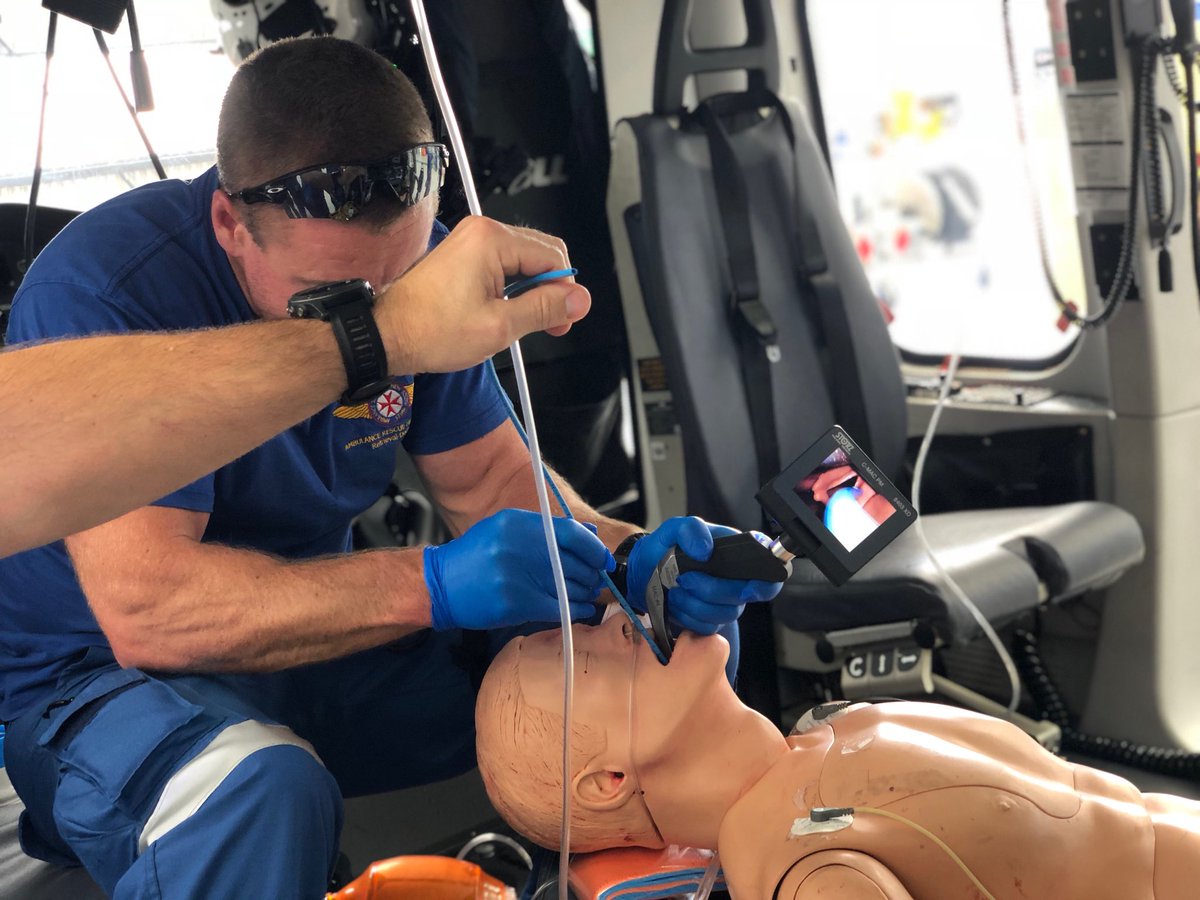
Image result for Intubation in a helicopter
Image courtesy Sydney HEMS. 

Aviation and medicine have long-complimented each other. Checklists are the first thing that comes to mind when thinking of this. The airline industry helped to revolutionize the medical industry with the system-wide adoption of checklists, and the acceptance of resource-management. I challenge you to find an O.R. that does not follow a checklist prior to making the first cut. (Hint: you won’t)

I was reminded of the similarities between aviation and medicine the other day while talking to a non-flying, never-intubated-anyone peer. He was asking me about RSI and all of the stuff that goes along with it. I could hear the tension in his voice as  he was thinking of himself in the hot-seat with a patient. Just the thought of dropping a difficult tube can get a medical provider in a tizzy, with or without a checklist. I found myself articulating something I have long held dear;

 Learn how to fail brilliantly. Be the best at failing.

This might sound odd, but hear me out. We are all going to miss tubes. Anyone that tells you they never missed a tube is lying. We all have or will miss that airway, and its how we fail that determines the patient's outcome. The planning for failure; being brilliant with your back-up plan assures that WHEN stuff DOES go south, you are the best at re-acclimating and implementing a solution. I also like the phrase “you can BLS someone all the way to Texas if you’re good at it!”

In the air medical world, failure carries a higher price. But, failures do happen. Engines quit, wheels don’t deploy, blades can go rapidly south. My advice is - even in this case - know how to fail brilliantly. You can have the best pilot in the world, but even he can’t make a helicopter NOT FAIL despite his many years of flying-experience.

I challenge you to think about this; how might your operation fail? And how can you be brilliant when it does?
Who is designated to make radio call outs in the event of an emergency?
Are you allowed to put the gear down?
Do you, in the left seat, spend time looking for appropriate LZs in case sh!t happens in a hurry?

Take some time and think about how you plan for failed-airways and apply that to your air operations. Checklists have pervaded the medical industry and made it a better place. Can we use the lessons learned in critical-care medicine to do the same for aviation?

Are you willing to be part of that success-story? As my pilot-friend Dan Foulds says, “You are not a passenger!  Learn as much as you can about aviation as fast as you can and be a contributing- member of your flight-team!"

Wednesday, January 30, 2019

It Can Happen to You Too...

It was bound to happen. As women entered the ranks of HEMS pilots, it was only a matter of time until misfortune struck one of them as it has so many men sitting at the controls.

It seems no one gets a pass. Take note, this could happen to you too. Are you doing everything possible to mitigate risk as you fly sick people?

For now, let's keep the families of these victims in our thoughts. As hard as it is, let's not speculate or say things that might make terrible pain even worse. Let's let the NTSB and the FAA do their jobs.

For now, let's consider these souls, and search our own.

Fly safely, friends...

HelicopterEMS.com


Monday, January 28, 2019

From our Facebook page: You! Incorporated!

Image courtesy Gary Christian


As we begin the annual misery known as tax preparation, we are again grateful to the friend who several years ago said,

"You do have an LLC, right?"

Maybe you are way ahead of us on this and have been enjoying the benefits of incorporating for awhile. If so, feel free to add to the discussion with a comment. Tax wizards we aren't - but we do like to save tax dollars.

Let's say you are a nurse or paramedic who occasionally teaches a class for an outside agency. Do you get a check made out to you as a contractor? If so you should incorporate.

Are you a pilot who does a bit of flying for a friend. Do you speak at AMTC or a regional conference? If you get paid in any regard for occasional work that you do and are not an employee of the payor - you should incorporate.

If you do two simple things you can enjoy many of the tax-saving benefits that large corporate entities do.

1. Go online and visit your secretary of state and create your corporation. Several years ago, we created a "sole-proprietor" limited liability company named AMRM Training Solutions. In Georgia it's cheap - and you do not need a lawyer or legal service. You can do it yourself. We pay $50.00 per year as a for-profit. That cost is tax deductible.

For Georgia visit

http://sos.ga.gov/index.php/corporations

If you happen to live in Michigan, you might start here

https://cofs.lara.state.mi.us/…/LoginS…/ListNewFilings.aspx…

2. File for a federal employer identification number. It's easy.
https://www.irs.gov/…/apply-for-an-employer-identification-….

If you do a gig that pays more than a few hundred dollars, the payor wants to deduct what they have paid you, so they will ask you to fill out a W-9 (it's online too). You will enter your EIN also known as your taxpayer ID number. At tax-filing time, your preparer will need the number for your return.

Of special note, when you start searching for these resources, lots of sites will present themselves as your go-to resource. They cost money. You don't need to pay money to a service to do these things. Make sure you are at the state or federal website and you can do it yourself. Those guys are trying to run a scam. They have official-looking websites and send official-looking letters designed to scam you.

So, what's the benefit of incorporation? Well, if you have a business and are out there generating revenue, lots of "household" costs are tax deductible. Do you have smartphones? Check. Internet service? Check. Do you drive your vehicle to a gig? Keep track of the miles because they are deductible. If you present at AMTC or ECHO, all the expenses are deductible because you are furthering the aims of your business. You are an industry expert sharing knowledge and looking for gigs. Right?
Notwithstanding the audit-scare from a few years back, the room in which you bang on your computer is deductible as a home-office. But don't take our word for it - ask your tax preparer.

From our perspective, this is purely for the purposes of reducing our tax burden. We write off the costs mentioned and others, and then "lose" another few thousand dollars each year. Do we "intend" to make a profit? Absolutely! And that means our corporation can continue to lose money (and allow us to pay fewer taxes) indefinitely.

Here's to You, Incorporated!